Showing posts with label Enceladus. Show all posts

Thursday, July 31, 2014

Elevated View of Enceladus' South Pole


This dramatic view looks across the region of Enceladus' geyser basin and down on the ends of the Baghdad and Damascus fractures that face Saturn. The image, which looks approximately in the direction of Saturn, was taken from a more elevated viewpoint than other Cassini survey images of this area of the moon's south pole.

The geysering segments of the fractures seen here are among the most active and warmest in the whole region. As seen from the spacecraft from an elevation angle of 25 degrees south, the jets are projected against the bright surface as opposed to black sky. Consequently, despite the pronounced activity, the jets appear fuzzy, or indistinct, in this image and their tilts are consequently not measurable. Though their source locations are clearly seen, this image was not used in the process of triangulation, but instead it was used to confirm source locations determined from triangulation using other images.

The image was taken with Cassini's narrow-angle camera through the clear filter on August 13, 2010, with an image scale about 230 feet (70 meters) per pixel and a Sun-Enceladus-spacecraft, or phase, angle of about 151 degrees.

This image was one of those used to confirm the sources of Enceladus' geysers as described in a paper by Porco, DiNino, and Nimmo, and published in the online version of the Astronomical Journal in July 2014: http://dx.doi.org/10.1088/0004-6256/148/3/45.

A companion paper, by Nimmo et al. is available at: http://dx.doi.org/10.1088/0004-6256/148/3/46.


Image credit: NASA/JPL-Caltech/Space Science Institute

Note: For more information, see PIA17186: Geyser Basin in 3-D, PIA17187: Enceladus' Plume Brightness Variations, PIA17188: Surveyor's Map of Enceladus' Geyser Basin, PIA17189: What Lies Beneath: Close Up View (Artist's Concept), PIA17190: What Lies Beneath: Regional View (Artist's Concept), and Cassini Spacecraft Reveals 101 Geysers and More on Icy Saturn Moon.

Wednesday, July 30, 2014

Enceladus Geysers


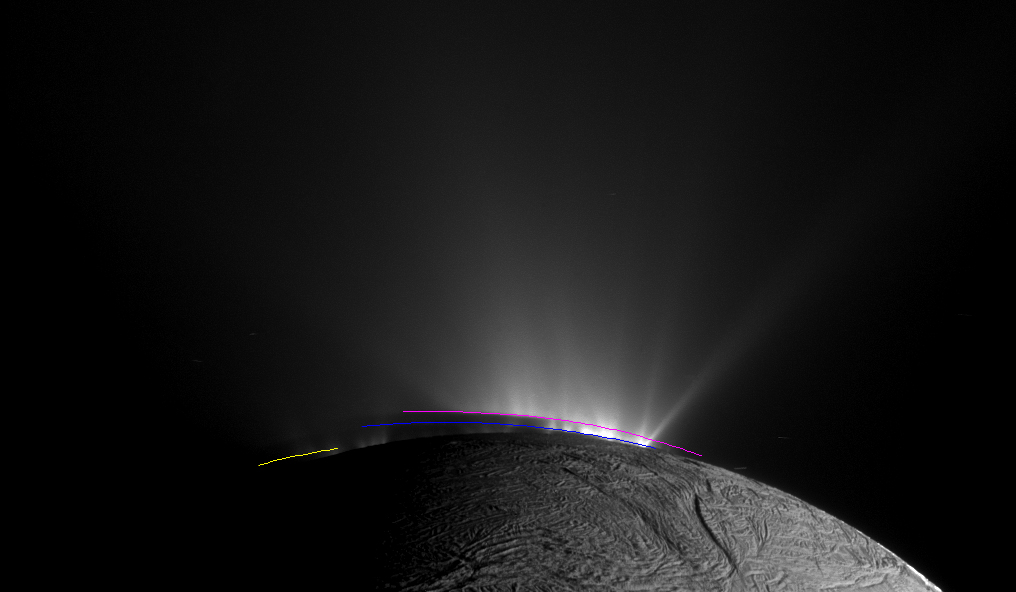
This Cassini narrow-angle camera image -- one of those acquired in the survey conducted by the Cassini imaging science team of the geyser basin at the south pole of Enceladus -- was taken as Cassini was looking across the moon's south pole. At the time, the spacecraft was essentially in the moon's equatorial plane. The image scale is 1280 feet (390 meters) per pixel and the sun-Enceladus-spacecraft, or phase, angle is 162.5 degrees.

The image was taken through the clear filter of the narrow angle camera on November 30, 2010, 1.4 years after southern autumnal equinox. The shadow of the body of Enceladus on the lower portions of the jets is clearly seen.

In an annotated version of the image, the colored lines represent the projection of Enceladus' shadow on a plane normal to the branch of the Cairo fracture (yellow line), normal to the Baghdad fracture (blue line) and normal to the Damascus fracture (pink line).

Post-equinox images like this, clearly showing the different projected locations of the intersection between the shadow and the curtain of jets from each fracture, were useful for scientists in checking the triangulated positions of the geysers, as described in a paper by Porco, DiNino, and Nimmo, and published in the online version of the Astronomical Journal in July 2014: http://dx.doi.org/10.1088/0004-6256/148/3/45.

A companion paper, by Nimmo et al. is available at: http://dx.doi.org/10.1088/0004-6256/148/3/46.

Image credit: NASA/JPL-Caltech/Space Science Institute

Note: For more information, see 101 Geysers on Icy Saturn Moon.

Saturday, April 5, 2014

Enceladus' Plumes


Dramatic plumes, both large and small, spray water ice out from many locations along the ‘tiger stripes’ near the south pole of Saturn’s moon Enceladus. The tiger stripes are fissures that spray icy particles, water vapor and organic compounds. More than 30 individual jets of different sizes can be seen in this image, which is a mosaic created from two high-resolution images captured when Cassini flew past Enceladus and through the jets on 21 November 2009. This view was obtained at a distance of about 14,000 km from Enceladus.

Image credit: NASA/JPL/Space Science Institute

Friday, April 4, 2014

Enceladus' Ocean


This diagram illustrates the possible interior of Saturn's moon Enceladus based on a gravity investigation by NASA's Cassini spacecraft and NASA's Deep Space Network, reported in April 2014. The gravity measurements suggest an ice outer shell and a low density, rocky core with a regional water ocean sandwiched in between at high southern latitudes.

Views from Cassini's imaging science subsystem were used to depict the surface geology of Enceladus and the plume of water jets gushing from fractures near the moon's south pole.

Enceladus is 313 miles (504 kilometers) in diameter.

Illustration credit: NASA/JPL-Caltech

Note: This is the big story of the day. For more information, see Inside Enceladus, Icy Moon Enceladus Has Underground Sea, NASA Space Assets Detect Ocean inside Saturn Moon, and Deep Ocean Detected Inside Saturn's Moon.

Thursday, January 2, 2014

Enceladus


Saturn's moon Enceladus, covered in snow and ice, resembles a perfectly packed snowball in this image from NASA's Cassini mission. Cassini has imaged Enceladus many times throughout its mission, discovering a fractured surface and the now-famous geysers that erupt icy particles and water vapor from fractures crossing the moons' 200-mile-wide (300-kilometer-wide) south polar terrain.

The mountain ridge seen in the south in this image is part of the undulating mountain belt that circumscribes this region.

See PIA11685 to learn more about the surface of Enceladus. See PIA11688 to learn about the jets of water ice emanating from the moon's south polar region.

This view looks toward the leading side of Enceladus (313 miles, 504 kilometers across). North on Enceladus is up and rotated 6 degrees to the left. The image was taken with the Cassini spacecraft narrow-angle camera on March 10, 2012, using filters sensitive to ultraviolet, visible and infrared light (spanning wavelengths from 338 to 750 nanometers).

The view was acquired at a distance of approximately 106,000 miles (170,000 kilometers) from Enceladus. Image scale is 3,336 feet (1 kilometer) per pixel.

Photo credit: NASA/JPL-Caltech/Space Science Institute

Note: For more information, see Cassini Sees Saturn and Moons in Holiday Dress.

Wednesday, January 1, 2014

Enceladus


NASA's Cassini captures a still and partially sunlit Enceladus. The Saturnian moon is covered in ice that reflects sunlight similar to freshly fallen snow, making Enceladus one of the most reflective objects in the solar system. The blue color in this false-color image indicates larger-than-average ice particles. The moon's surface is decorated with fractures, folds and ridges caused by tectonic stresses. For more about the tectonics on Enceladus see PIA11686.

This view looks toward the side of Enceladus (313 miles or 504 kilometers across) that faces backward in the moon's orbit around Saturn. North on Enceladus is up. The images were taken with the Cassini spacecraft narrow-angle camera on April 7, 2010, using filters sensitive to ultraviolet, visible and infrared light (spanning wavelengths from 338 to 750 nanometers).

The view was acquired at a distance of approximately 123,000 miles (198,000 kilometers) from Enceladus. Image scale is 3,889 feet (1 kilometer) per pixel.

Photo credit: NASA/JPL-Caltech/Space Science Institute

Note: For more information, see Cassini Sees Saturn and Moons in Holiday Dress.

Wednesday, November 13, 2013

Saturn, with Earth, Venus and Mars


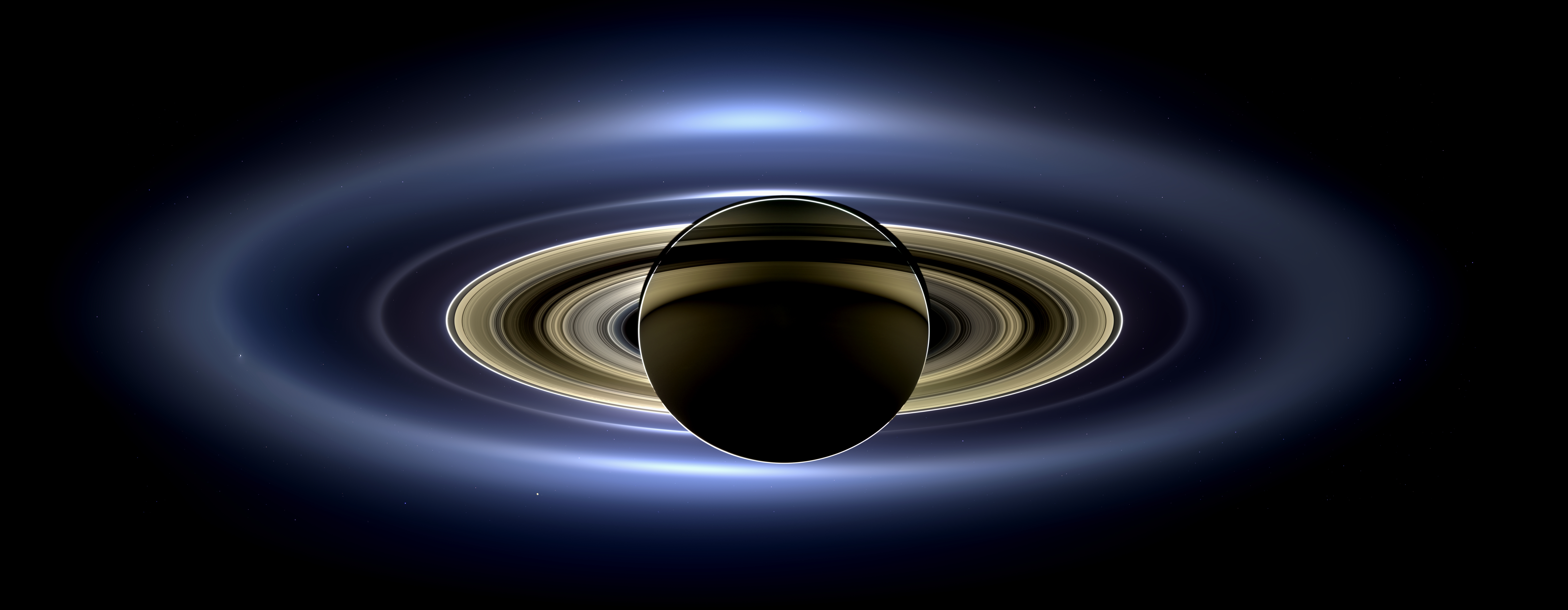
On July 19, 2013, in an event celebrated the world over, NASA's Cassini spacecraft slipped into Saturn's shadow and turned to image the planet, seven of its moons, its inner rings -- and, in the background, our home planet, Earth.

With the sun's powerful and potentially damaging rays eclipsed by Saturn itself, Cassini's onboard cameras were able to take advantage of this unique viewing geometry. They acquired a panoramic mosaic of the Saturn system that allows scientists to see details in the rings and throughout the system as they are backlit by the sun. This mosaic is special as it marks the third time our home planet was imaged from the outer solar system; the second time it was imaged by Cassini from Saturn's orbit; and the first time ever that inhabitants of Earth were made aware in advance that their photo would be taken from such a great distance.

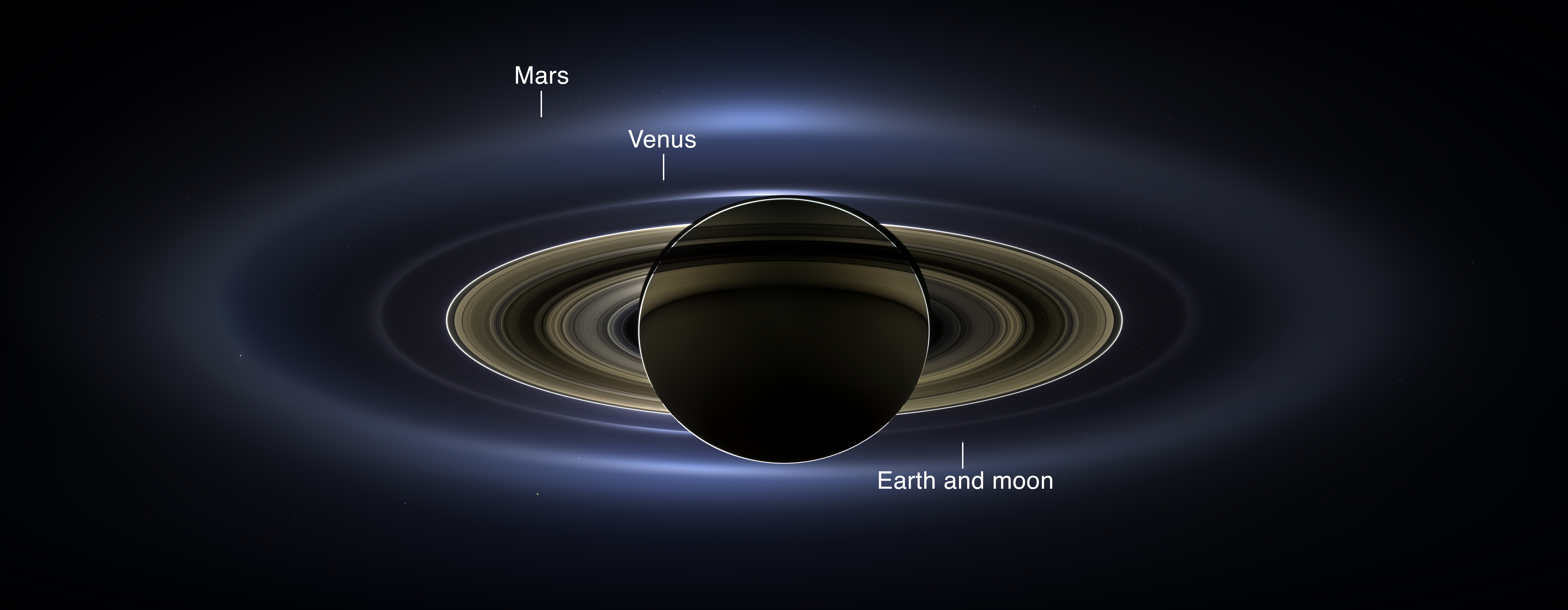
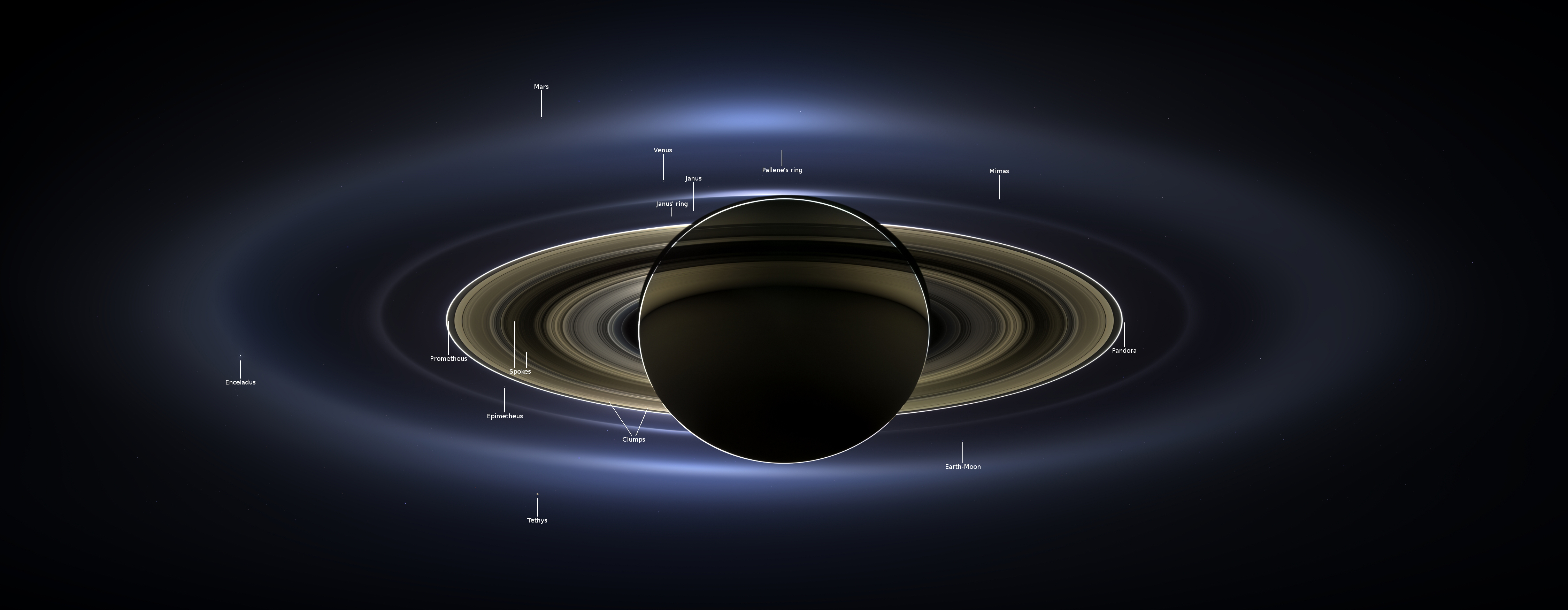
With both Cassini's wide-angle and narrow-angle cameras aimed at Saturn, Cassini was able to capture 323 images in just over four hours. This final mosaic uses 141 of those wide-angle images. Images taken using the red, green and blue spectral filters of the wide-angle camera were combined and mosaicked together to create this natural-color view. A brightened version with contrast and color enhanced (Figure 1), a version with just the planets annotated (Figure 2), and an annotated version (Figure 3) are shown above.

This image spans about 404,880 miles (651,591 kilometers) across.

The outermost ring shown here is Saturn's E ring, the core of which is situated about 149,000 miles (240,000 kilometers) from Saturn. The geysers erupting from the south polar terrain of the moon Enceladus supply the fine icy particles that comprise the E ring; diffraction by sunlight gives the ring its blue color. Enceladus (313 miles, or 504 kilometers, across) and the extended plume formed by its jets are visible, embedded in the E ring on the left side of the mosaic.

At the 12 o'clock position and a bit inward from the E ring lies the barely discernible ring created by the tiny, Cassini-discovered moon, Pallene (3 miles, or 4 kilometers, across). (For more on structures like Pallene's ring, see PIA08328). The next narrow and easily seen ring inward is the G ring. Interior to the G ring, near the 11 o'clock position, one can barely see the more diffuse ring created by the co-orbital moons, Janus (111 miles, or 179 kilometers, across) and Epimetheus (70 miles, or 113 kilometers, across). Farther inward, we see the very bright F ring closely encircling the main rings of Saturn.

Following the outermost E ring counter-clockwise from Enceladus, the moon Tethys (662 miles, or 1,066 kilometers, across) appears as a large yellow orb just outside of the E ring. Tethys is positioned on the illuminated side of Saturn; its icy surface is shining brightly from yellow sunlight reflected by Saturn. Continuing to about the 2 o'clock position is a dark pixel just outside of the G ring; this dark pixel is Saturn's Death Star moon, Mimas (246 miles, or 396 kilometers, across). Mimas appears, upon close inspection, as a very thin crescent because Cassini is looking mostly at its non-illuminated face.

The moons Prometheus, Pandora, Janus and Epimetheus are also visible in the mosaic near Saturn's bright narrow F ring. Prometheus (53 miles, or 86 kilometers, across) is visible as a faint black dot just inside the F ring and at the 9 o'clock position. On the opposite side of the rings, just outside the F ring, Pandora (50 miles, or 81 kilometers, across) can be seen as a bright white dot. Pandora and Prometheus are shepherd moons and gravitational interactions between the ring and the moons keep the F ring narrowly confined. At the 11 o'clock position in between the F ring and the G ring, Janus (111 miles, or 179 kilometers, across) appears as a faint black dot. Janus and Prometheus are dark for the same reason Mimas is mostly dark: we are looking at their non-illuminated sides in this mosaic. Midway between the F ring and the G ring, at about the 8 o'clock position, is a single bright pixel, Epimetheus. Looking more closely at Enceladus, Mimas and Tethys, especially in the brightened version of the mosaic, one can see these moons casting shadows through the E ring like a telephone pole might cast a shadow through a fog.

In the non-brightened version of the mosaic, one can see bright clumps of ring material orbiting within the Encke gap near the outer edge of the main rings and immediately to the lower left of the globe of Saturn. Also, in the dark B ring within the main rings, at the 9 o'clock position, one can see the faint outlines of two spoke features, first sighted by NASA's Voyager spacecraft in the early 1980s and extensively studied by Cassini.

Finally, in the lower right of the mosaic, in between the bright blue E ring and the faint but defined G ring, is the pale blue dot of our planet, Earth. Look closely and you can see the moon protruding from the Earth's lower right. (For a higher resolution view of the Earth and moon taken during this campaign, see PIA14949.) Earth's twin, Venus, appears as a bright white dot in the upper left quadrant of the mosaic, also between the G and E rings. Mars also appears as a faint red dot embedded in the outer edge of the E ring, above and to the left of Venus.

For ease of visibility, Earth, Venus, Mars, Enceladus, Epimetheus and Pandora were all brightened by a factor of eight and a half relative to Saturn. Tethys was brightened by a factor of four. In total, 809 background stars are visible and were brightened by a factor ranging from six, for the brightest stars, to 16, for the faintest. The faint outer rings (from the G ring to the E ring) were also brightened relative to the already bright main rings by factors ranging from two to eight, with the lower-phase-angle (and therefore fainter) regions of these rings brightened the most. The brightened version of the mosaic was further brightened and contrast-enhanced all over to accommodate print applications and a wide range of computer-screen viewing conditions.

Some ring features -- such as full rings traced out by tiny moons -- do not appear in this version of the mosaic because they require extreme computer enhancement, which would adversely affect the rest of the mosaic. This version was processed for balance and beauty.

This view looks toward the unlit side of the rings from about 17 degrees below the ring plane. Cassini was approximately 746,000 miles (1.2 million kilometers) from Saturn when the images in this mosaic were taken. Image scale on Saturn is about 45 miles (72 kilometers) per pixel.

This mosaic was made from pictures taken over a span of more than four hours while the planets, moons and stars were all moving relative to Cassini. Thus, due to spacecraft motion, these objects in the locations shown here were not in these specific places over the entire duration of the imaging campaign. Note also that Venus appears far from Earth, as does Mars, because they were on the opposite side of the sun from Earth.

Image credit: NASA/JPL-Caltech/SSI

Note: For more information, see NASA Cassini Spacecraft Provides New View of Saturn and Earth, PIA17679: The Faces of 'Wave at Saturn' and Spectacular New View of Saturn and Earth. From earlier in the year, see Cassini to Photograph Earth From Deep Space and Cassini Releases Image of Earth Waving at Saturn.

Tuesday, November 5, 2013

Quintet of Moons


Five moons pose for the international Cassini spacecraft to create this beautiful portrait with Saturn’s rings.

This view, from 29 July 2011, looks toward the northern, sunlit side of the rings from just above the ringplane.

At the far right, and obscuring Saturn itself, is the planet’s second largest moon Rhea, which spans 1528 km. Rhea is closest to Cassini in this composition, at a distance of 1.1 million kilometers. Its heavily cratered surface bears witness to a violent history, with many craters overlapping or erasing the traces of older impact events.

The nearly 400 km-wide Mimas lies just beyond, and seemingly levitates just above Saturn’s innermost rings. The outline of the moon’s large, distinguishing crater Herschel is partially covered by Rhea, but can just be made out along with numerous smaller craters.

Brightly reflective Enceladus appears above the center of the image and lies beyond the rings, at a distance of 1.8 million kilometers from Cassini. Although not visible in this image, icy Enceladus is covered with a network of frozen ridges and troughs, with plumes of ice particles jetting from fissures in its southern hemisphere.

To the lower left, tiny Pandora, just 81 km across, appears skewered by Saturn’s outer rings – in fact, it orbits between the planet’s A and F rings.

Last but not least, the irregularly shaped Janus lies at the far left of the image, several shadowy surface markings corresponding to large impact craters.

Photo credit: NASA/JPL-Caltech/Space Science Institute

Tuesday, September 24, 2013

Enceladus


Enceladus's unusual plume is only easily visible when the Cassini spacecraft and the Sun are on opposite sides of Enceladus. So what's lighting up the moon then? It's light reflected off Saturn. This lighting trick allows the Cassini spacecraft to capture both the back-lit plume and the surface of Enceladus in one shot.

This view looks toward the Saturn-facing hemisphere of Enceladus. North on Enceladus is up. The image was taken in blue light with the Cassini spacecraft narrow-angle camera on April 2, 2013.

The view was acquired at a distance of approximately 517,000 miles (832,000 kilometers) from Enceladus and at a Sun-Enceladus-spacecraft, or phase, angle of 175 degrees. Image scale is 3 miles (5 kilometers) per pixel.

Photo credit: NASA/JPL-Caltech/Space Science Institute

Thursday, August 1, 2013

Squeezing and Releasing Enceladus


This set of images from NASA's Cassini mission shows how the gravitational pull of Saturn affects the amount of spray coming from jets at the active moon Enceladus. Enceladus has the most spray when it is farthest away from Saturn in its orbit (inset image on the left) and the least spray when it is closest to Saturn (inset image on the right).

Water ice and organic particles gush out of fissures known as "tiger stripes" at Enceladus' south pole. Scientists think the fissures are squeezed shut when the moon is feeling the greatest force of Saturn's gravity. They theorize the reduction of that gravity allows the fissures to open and release the spray. Enceladus' orbit is slightly closer to Saturn on one side than the other. A simplified version of that orbit is shown as a white oval.

Scientists correlate the brightness of the Enceladus plume to the amount of solid material being ejected because the fine grains of water ice in the plume are very bright when lit from behind. Between the dimmest and brightest images, they detected a change of about three to four times in brightness, approximately the same as moving from a dim hallway to a brightly lit office.

This analysis is the first clear finding that shows the jets at Enceladus vary in a predictable manner. The background image is a mosaic made from data obtained by Cassini's imaging science subsystem in 2006. The inset image on the left was obtained on October 1, 2011. The inset image on the right was obtained on January 30, 2011.

A related image, PIA17039, shows just the Enceladus images. The Saturn system mosaic was created from data obtained by Cassini's imaging cameras in 2006.

Image credit: NASA/JPL-Caltech/University of Arizona/Cornell/SSI

Note: For more information, see PIA17039: Enceladus "On" and "Off"; also, NASA's Cassini Sees Forces Controlling Enceladus Jets.

Tuesday, July 30, 2013

Crescent Enceladus


Evoking the haunting beauty of Earth's Moon, a crescent Enceladus appears in the skies around Saturn.

Lit terrain seen here is on the Saturn-facing hemisphere of Enceladus. North on Enceladus is up and rotated 25 degrees to the right. The image was taken in visible light with the Cassini spacecraft narrow-angle camera on May 1, 2013.

The view was acquired at a distance of approximately 329,000 miles (530,000 kilometers) from Enceladus and at a Sun-Enceladus-spacecraft, or phase, angle of 138 degrees. Image scale is 2 miles (3 kilometers) per pixel.

Photo credit: NASA/JPL-Caltech/Space Science Institute

Wednesday, June 19, 2013

Earth as a Pale Blue Dot and Saturn's Silhouette


With giant Saturn hanging in the blackness and sheltering Cassini from the sun's blinding glare, the spacecraft viewed the rings as never before, revealing previously unknown faint rings and even glimpsing its home world.

This marvelous panoramic view was created by combining a total of 165 images taken by the Cassini wide-angle camera over nearly three hours on September 15, 2006. The full mosaic consists of three rows of nine wide-angle camera footprints; only a portion of the full mosaic is shown here. Color in the view was created by digitally compositing ultraviolet, infrared and clear filter images and was then adjusted to resemble natural color.

The mosaic images were acquired as the spacecraft drifted in the darkness of Saturn's shadow for about 12 hours, allowing a multitude of unique observations of the microscopic particles that compose Saturn's faint rings.

Ring structures containing these tiny particles brighten substantially at high phase angles: i.e., viewing angles where the sun is almost directly behind the objects being imaged.

During this period of observation Cassini detected two new faint rings: one coincident with the shared orbit of the moons Janus and Epimetheus, and another coincident with Pallene's orbit. (See PIA08322 and PIA08328 for more on the two new rings.)

The narrowly confined G ring is easily seen here, outside the bright main rings. Encircling the entire system is the much more extended E ring. The icy plumes of Enceladus, whose eruptions supply the E ring particles, betray the moon's position in the E ring's left-side edge.

Interior to the G ring and above the brighter main rings is the pale dot of Earth. Cassini views its point of origin from over a billion kilometers (and close to a billion miles) away in the icy depths of the outer solar system. See PIA08324 for a similar view of Earth taken during this observation.

Small grains are pushed about by sunlight and electromagnetic forces. Hence, their distribution tells much about the local space environment.

A second version of the mosaic view is presented here in which the color contrast is greatly exaggerated. In such views, imaging scientists have noticed color variations across the diffuse rings that imply active processes sort the particles in the ring according to their sizes.

Looking at the E ring in this color-exaggerated view, the distribution of color across and along the ring appears to be different between the right side and the left. Scientists are not sure yet how to explain these differences, though the difference in phase angle between right and left may be part of the explanation. The phase angle is about 179 degrees on Saturn.

The main rings are overexposed in a few places.

This view looks toward the unlit side of the rings from about 15 degrees above the ringplane.

Cassini was approximately 2.2 million kilometers (1.3 million miles) from Saturn when the images in this mosaic were taken. Image scale on Saturn is about 260 kilometers (162 miles) per pixel.

Image credit: NASA/JPL/Space Science Institute

Note: For more information, see Cassini Probe to Take Photo of Earth From Deep Space; also, Cassini to Photograph Earth From Deep Space.

Tuesday, April 30, 2013

Enceladus


Like a proud peacock displaying its tail, Enceladus shows off its beautiful plume to the Cassini spacecraft's cameras.

Enceladus (313 miles, or 504 kilometers across) is seen here illuminated by light reflected off Saturn.

This view looks toward the Saturn-facing side of Enceladus. North on Enceladus is up and rotated 45 degrees to the right. The image was taken in visible light with the Cassini spacecraft narrow-angle camera on Jan. 18, 2013.

The view was acquired at a distance of approximately 483,000 miles (777,000 kilometers) from Enceladus and at a Sun-Enceladus-spacecraft, or phase, angle of 173 degrees. Image scale is 3 miles (5 kilometers) per pixel.

Photo credit: NASA/JPL-Caltech/Space Science Institute

Thursday, April 25, 2013

Enceladus


This face-on color view of Enceladus was taken by the international Cassini spacecraft on 31 January 2011, from a distance of 81,000 km, and processed by amateur astronomer Gordan Ugarković.

Image credit: NASA/JPL-Caltech/SSI/G. Ugarković

Wednesday, March 27, 2013

Dione, Rhea and Enceladus


The Cassini spacecraft observes three of Saturn's moons set against the darkened night side of the planet.

Saturn is present on the left this image but is too dark to see. Rhea (1,528 kilometers, or 949 miles across) is closest to Cassini here and appears largest at the center of the image. Enceladus (504 kilometers, or 313 miles across) is to the right of Rhea. Dione (1,123 kilometers, or 698 miles across) is to the left of Rhea, partly obscured by Saturn.

This view looks toward the northern, sunlit side of the rings from just above the ringplane.

The image was taken in visible red light with the Cassini spacecraft narrow-angle camera on April 25, 2011. The view was obtained at a distance of approximately 2.2 million kilometers (1.4 million miles) from Rhea and at a Sun-Rhea-spacecraft, or phase, angle of 67 degrees. Image scale is 13 kilometers (8 miles) per pixel on Rhea. The view was obtained at a distance of approximately 3 million kilometers (1.9 million miles) from Enceladus and at a phase angle of 67 degrees. Image scale is 18 kilometers (11 miles) per pixel on Enceladus. The view was obtained at a distance of approximately 3.1 million kilometers (1.9 million miles) from Dione and at a phase angle of 67 degrees. Image scale is 19 kilometers (12 miles) per pixel on Dione.

Photo credit: NASA/JPL/Space Science Institute

Thursday, January 17, 2013

Saturn Secrets Revealed


Thirty years ago the Voyager spacecraft offered the first closeup views of Saturn. Launched in 1997 Cassini-Huygens, a joint NASA/ESA/ASI mission, arrived around Saturn in July 2004 and the Huygens Probe landed on Titan, Saturn's largest moon, in January 2005. The ESA probe was the first to land on a world in the outer Solar System. Since 2005 Cassini-Huygens mission has obtained infinitely more detailed and beautiful images of the ringed planet and its many moons. Data from Cassini and Huygens are offering clues about how life began on Earth.

Text credit: ESA; video credit: ESA.

Thursday, January 10, 2013

Sunset on Enceladus' Jets


As the long winter night deepens at Enceladus' south pole, its jets are also progressively falling into darkness. The shadow of the moon itself is slowly creeping up the jets making the portions closest to the surface difficult to observe by the Cassini spacecraft.

Cassini looks toward the night side of Enceladus (313 miles, or 504 kilometers across) in this image. Enceladus is lit by light reflected off Saturn rather than by direct sunlight.

This view looks toward the Saturn-facing hemisphere of Enceladus. North on Enceladus is up. The image was taken with the Cassini spacecraft narrow-angle camera on September 24, 2012 using a spectral filter sensitive to wavelengths of near-infrared light centered at 930 nanometers.

The view was acquired at a distance of approximately 452,000 miles (728,000 kilometers) from Enceladus and at a Sun-Enceladus-spacecraft, or phase, angle of 170 degrees. Scale in the original image was 3 miles (4 kilometers) per pixel. The image was magnified by a factor of three to enhance the visibility of jets.


Photo credit: NASA/JPL-Caltech/Space Science Institute

Tuesday, July 17, 2012

Partial Eclipse of Enceladus, with Titan


Saturn's moon Enceladus is partially eclipsed by the planet in this Cassini spacecraft view which also features the moon Titan in the distance.

Cassini flew by Enceladus, shown in the center of the view, at a distance of about 16,000 miles (26,000 kilometers). The terminator between the day and night sides of Enceladus (313 miles, or 504 kilometers across) can be seen on the far left of the moon, while the shadow of the eclipsing planet runs across the bottom.

Titan (3,200 miles, or 5,150 kilometers across) is in the bottom right of this image and is about 684,000 miles (1.1 million kilometers) from the spacecraft. See PIA11508 to see Titan eclipsed by the planet.

This view looks toward the Saturn-facing sides of Enceladus and Titan. North is up.

The image was taken in visible light with the Cassini spacecraft wide-angle camera on October 1, 2011. The view was obtained at a Sun-Enceladus-spacecraft, or phase, angle of 29 degrees. Scale in the original image was 2 miles (3 kilometers) per pixel on Enceladus. The image was contrast enhanced and magnified by a factor of 1.5 to enhance the visibility of surface features.

Photo credit: NASA/JPL-Caltech/Space Science Institute

Tuesday, July 3, 2012

The Shadow of Enceladus on Saturn


Saturn's rings cast wide shadows on the planet, and the shadow of a moon also graces the gas giant in this scene from the Cassini spacecraft.

The moon Enceladus is not shown in this view, but it does cast a small, elongated shadow on the planet near the bottom of this view. The moon Mimas (246 miles, or 396 kilometers across) is visible as a bright dot on the far right of the image in the ring plane.

This view looks toward the southern, unilluminated side of the rings from about 2 degrees below the ringplane.

The image was taken with the Cassini spacecraft wide-angle camera on Jan. 14, 2012 using a spectral filter sensitive to wavelengths of near-infrared light centered at 752 nanometers. The view was acquired at a distance of approximately 1.7 million miles (2.8 million kilometers) from Saturn and at a Sun-Saturn-spacecraft, or phase, angle of 51 degrees. Image scale is 105 miles (170 kilometers) per pixel.

Photo credit: NASA/JPL-Caltech/Space Science Institute

Tuesday, May 1, 2012

Tethys, Enceladus and Saturn


A pair of Saturn's many moons joins the planet in this Cassini spacecraft scene.

Tethys (660 miles, or 1,062 kilometers across) appears as a small white dot above the rings on the far left of the image. Enceladus (313 miles, or 504 kilometers across) appears as a smaller bright speck beside the planet as seen from this vantage point. The rings cast wide shadows on the planet's southern latitudes.

This view looks toward the southern, unilluminated side of the rings from about 1 degree below the ringplane.

The image was taken in visible green light with the Cassini spacecraft wide-angle camera on January 19, 2012. The view was obtained at a distance of approximately 1.8 million miles (2.9 million kilometers) from Saturn and at a Sun-Saturn-spacecraft, or phase, angle of 63 degrees. Image scale is 104 miles (167 kilometers) per pixel on Saturn.

Photo credit: NASA/JPL-Caltech/Space Science Institute