Showing posts with label F-Ring. Show all posts

Tuesday, October 14, 2014

Tethys and the A- and F-Rings


Like a drop of dew hanging on a leaf, Tethys appears to be stuck to the A and F rings from this perspective.

Tethys (660 miles, or 1,062 kilometers across), like the ring particles, is composed primarily of ice. The gap in the A ring through which Tethys is visible is the Keeler gap, which is kept clear by the small moon Daphnis (not visible here).

This view looks toward the Saturn-facing hemisphere of Tethys. North on Tethys is up and rotated 43 degrees to the right. The image was taken in visible light with the Cassini spacecraft narrow-angle camera on July 14, 2014.

The view was acquired at a distance of approximately 1.1 million miles (1.8 million kilometers) from Tethys and at a Sun-Tethys-spacecraft, or phase, angle of 22 degrees. Image scale is 7 miles (11 kilometers) per pixel.

Image credit: NASA/JPL-Caltech/Space Science Institute

Wednesday, September 24, 2014

Tethys, Hyperion, Prometheus, and the Rings


The Cassini spacecraft captures a rare family photo of three of Saturn's moons that couldn't be more different from each other! As the largest of the three, Tethys (image center) is round and has a variety of terrains across its surface. Meanwhile, Hyperion (to the upper-left of Tethys) is the "wild one" with a chaotic spin and Prometheus (lower-left) is a tiny moon that busies itself sculpting the F ring.

To learn more about the surface of Tethys (660 miles, or 1,062 kilometers across), see PIA17164. More on the chaotic spin of Hyperion (168 miles, or 270 kilometers across) can be found at PIA07683. And discover more about the role of Prometheus (53 miles, or 86 kilometers across) in shaping the F ring in PIA12786.

This view looks toward the sunlit side of the rings from about 1 degree above the ringplane. The image was taken in visible light with the Cassini spacecraft narrow-angle camera on July 14, 2014.

The view was acquired at a distance of approximately 1.2 million miles (1.9 million kilometers) from Tethys and at a Sun-Tethys-spacecraft, or phase, angle of 22 degrees. Image scale is 7 miles (11 kilometers) per pixel.

Image credit: NASA/JPL-Caltech/Space Science Institute

Wednesday, September 10, 2014

Bright Clumps in Saturn Ring Now Mysteriously Scarce


A map of Saturn's F ring from 2006 shows one of the few bright, extended clumps (indicated by a green box) seen during six years of observation by Cassini.

Compared to the age of the solar system -- about four-and-a-half billion years -- a couple of decades are next to nothing. Some planetary locales change little over many millions of years, so for scientists who study the planets, any object that evolves on such a short interval makes for a tempting target for study. And so it is with the ever-changing rings of Saturn.

Case in point: Saturn's narrow, chaotic and clumpy F ring. A recent NASA-funded study compared the F ring's appearance in six years of observations by the Cassini mission to its appearance during the Saturn flybys of NASA's Voyager mission, 30 years earlier. The study team found that, while the overall number of clumps in the F ring remained the same, the number of exceptionally bright clumps of material plummeted during that time. While the Voyagers saw two or three bright clumps in any given observation, Cassini spied only two of the features during a six-year period. What physical processes, they wondered, could cause only the brightest of these features to decline sharply?

While a variety of features in Saturn's many rings display marked changes over multiple years, the F ring seems to change on a scale of days, and even hours. Trying to work out what is responsible for the ring's tumultuous behavior is a major goal for ring scientists working on Cassini.

"Saturn's F ring looks fundamentally different from the time of Voyager to the Cassini era," said Robert French of the SETI Institute in Mountain View, California, who led the study along with SETI Principal Investigator Mark Showalter. "It makes for an irresistible mystery for us to investigate."

The researchers hypothesize that the brightest clumps in the F ring are caused by repeated impacts into its core by small moonlets up to about 3 miles (5 kilometers) wide, whose paths around Saturn lie close to the ring and cross into it every orbit. They propose that the diminishing number of bright clumps results from a drop in the number of these little moonlets between the Voyager and Cassini eras.

As for what might have caused the moonlets to become scarce, the team has a suspect: Saturn's moon Prometheus. The F ring encircles the planet at a special location, near a place called the Roche limit -- get any closer to Saturn than this, and tidal forces from the planet's gravity tear apart smaller bodies. "Material at this distance from Saturn can't decide whether it wants to remain as a ring or coalesce to form a moon," French said. Prometheus orbits just inside the F ring, and adds to the pandemonium by stirring up the ring particles, sometimes leading to the creation of moonlets, and sometimes leading to their destruction.

Every 17 years, the orbit of Prometheus aligns with the orbit of the F ring in such a way that its influence is particularly strong. The study team thinks this periodic alignment might spur the creation of many new moonlets. The moonlets would then crash repeatedly through the F ring, like cars in a Hollywood high-speed chase, creating bright clumps as they smash across lanes of ring material. Fewer clumps would be created as time goes by, because the moonlets themselves are eventually destroyed by all the crashes.

As with any good scientific hypothesis, the researchers offer a way to test their ideas. It happens that the Voyager encounters with Saturn occurred a few years after the 1975 alignment between Prometheus and the F ring, and Cassini was present for the 2009 alignment. If the moon's periodic influence is indeed responsible for creating new moonlets, then the researchers expect that Cassini would see the F ring return to a Voyager-like number of bright clumps in the next couple of years.

"Cassini's continued presence at Saturn gives us an interesting opportunity to test this prediction," said Linda Spilker, Cassini project scientist at NASA's Jet Propulsion Laboratory in Pasadena, California, who was not involved in the study. "Whatever the result, we're certain to learn something valuable about how rings, as well as planets and moons, form and evolve."

The study by French and colleagues was published in the online edition of the Journal Icarus on July 15, 2014.

Image credit: NASA/JPL-Caltech/SSI

Tuesday, August 12, 2014

Pandora and the Rings


The F ring shepherd Pandora is captured here along with other well-known examples of how Saturn’s moons shape the rings. From the narrow F ring, to the gaps in the A ring, to the Cassini Division, Saturn's rings are a masterpiece of gravitational sculpting by the moons.

Pandora (50 miles, or 81 kilometers across), along with its fellow shepherd Prometheus (53 miles, or 86 kilometers across), helps confine the F ring and keep it from spreading.

This view looks toward the unilluminated side of the rings from about 31 degrees below the ringplane. The image was taken in visible light with the Cassini spacecraft wide-angle camera on March 8, 2014.

The view was obtained at a distance of approximately 533,000 miles (858,000 kilometers) from Saturn and at a Sun-Saturn-spacecraft, or phase, angle of 63 degrees. Image scale is 32 miles (51 kilometers) per pixel.

Image credit: NASA/JPL-Caltech/Space Science Institute

Note: For more information, see Shepherd and Flock.

Tuesday, July 15, 2014

Prometheus and the Rings


Seen within the vast expanse of Saturn's rings, Prometheus appears as little more than a dot. But that little moon still manages to shape the F ring, confining it to its narrow domain.

Prometheus (53 miles, or 86 kilometers across) and its fellow moon Pandora (50 miles, or 81 kilometers across) orbit beside the F ring and keep the ring from spreading outward through a process dubbed "shepherding."

This view looks toward the unilluminated side of the rings from about 45 degrees below the ringplane. The image was taken in green light with the Cassini spacecraft wide-angle camera on March 8, 2014.

The view was obtained at a distance of approximately 533,000 miles (858,000 kilometers) from Prometheus and at a Sun-Prometheus-spacecraft, or phase, angle of 90 degrees. Image scale is 32 miles (51 kilometers) per pixel.

Image credit: NASA/JPL-Caltech/Space Science Institute

Tuesday, June 10, 2014

F-Ring Streamer-Channels


Prometheus is caught in the act of creating gores and streamers in the F ring. Scientists believe that Prometheus and its partner-moon Pandora are responsible for much of the structure in the F ring.

The orbit of Prometheus (53 miles, or 86 kilometers across) regularly brings it into the F ring. When this happens, it creates gores, or channels, in the ring where it entered. Prometheus then draws ring material with it as it exits the ring, leaving streamers in its wake. This process creates the pattern of structures seen in this image. This process is described in detail, along with a movie of Prometheus creating one of the streamer/channel features, in PIA08397.

This view looks toward the sunlit side of the rings from about 8.6 degrees above the ringplane. The image was taken in visible light with the Cassini spacecraft narrow-angle camera on February 11, 2014.

The view was acquired at a distance of approximately 1.3 million miles (2.1 million kilometers) from Saturn and at a Sun-Saturn-spacecraft, or phase, angle of 147 degrees. Image scale is 8 miles (13 kilometers) per pixel.

Image credit: NASA/JPL-Caltech/Space Science Institute

Friday, May 2, 2014

Uranus from Saturn


This view from NASA's Cassini spacecraft features a blue planet, but unlike the view from July 19, 2013 (PIA17172) that featured our home planet, this blue orb is Uranus, imaged by Cassini for the first time.

Uranus is a pale blue in this natural color image because its visible atmosphere contains methane gas and few aerosols or clouds. Methane on Uranus -- and its sapphire-colored sibling, Neptune -- absorbs red wavelengths of incoming sunlight, but allows blue wavelengths to escape back into space, resulting in the predominantly bluish color seen here. Cassini imaging scientists combined red, green and blue spectral filter images to create a final image that represents what human eyes might see from the vantage point of the spacecraft.

Uranus has been brightened by a factor of 4.5 to make it more easily visible. The outer portion of Saturn's A ring, seen at bottom right, has been brightened by a factor of two. The bright ring cutting across the image center is Saturn's narrow F ring.

Uranus was approximately 28.6 astronomical units from Cassini and Saturn when this view was obtained. An astronomical unit is the average distance from Earth to the sun, equal to 93,000,000 miles (150,000,000 kilometers).

This view was acquired by the Cassini narrow-angle camera at a distance of approximately 614,300 miles (988,600 kilometers) from Saturn on April 11, 2014. Image scale at Uranus is approximately 16,000 miles (25,700 kilometers) per pixel. Image scale at Saturn's rings is approximately 4 miles (6 kilometers) per pixel. In the image, the disk of Uranus is just barely resolved. The solar phase angle at Uranus, seen from Cassini, is 11.9 degrees.

Image credit: NASA/JPL-Caltech/Space Science Institute

Note: For more information, see Cassini Spies the Ice-Giant Planet Uranus.

Tuesday, April 1, 2014

Prometheus and the F-Ring


Saturn's moon Prometheus orbits near some of its handiwork in the F ring.

Prometheus (53 miles, or 86 kilometers across) and its partner Pandora gravitationally sculpt and maintain the narrow F ring.

This view looks toward the unilluminated side of the rings from about 53 degrees below the ringplane. The image was taken in visible light with the Cassini spacecraft narrow-angle camera on August 24, 2013.

The view was acquired at a distance of approximately 1.1 million miles (1.8 million kilometers) from Saturn and at a Sun-Saturn-spacecraft, or phase, angle of 104 degrees. Image scale is 7 miles (11 kilometers) per pixel.

Photo credit: NASA/JPL-Caltech/Space Science Institute

Tuesday, March 25, 2014

Epimetheus, Janus, Pandora and Prometheus Amid the Rings


Two pairs of moons make a rare joint appearance. The F ring's shepherd moons, Prometheus and Pandora, appear just inside and outside of the F ring (the thin faint ring furthest from Saturn). Meanwhile, farther from Saturn the co-orbital moons Janus (near the bottom) and Epimetheus (about a third of the way down from the top) also are captured.

Prometheus (53 miles, or 86 kilometers across) and Pandora (50 miles, or 81 kilometers across) sculpt the F ring through their gravitational influences. Janus (111 miles, or 179 kilometers across) and Epimetheus (70 miles, or 113 kilometers across) are famous for their orbital dance, swapping places about every four years. They are also responsible for gravitationally shaping the outer edge of the A ring into seven scallops.

This view looks toward the sunlit side of the rings from about 47 degrees above the ringplane. The image was taken in visible light with the Cassini spacecraft wide-angle camera on October 11, 2013.

The view was acquired at a distance of approximately 810,000 miles (1.3 million kilometers) from Saturn and at a Sun-Saturn-spacecraft, or phase, angle of 47 degrees. Image scale is 47 miles (76 kilometers) per pixel.

Photo credit: NASA/JPL-Caltech/Space Science Institute

Tuesday, February 11, 2014

F-Ring Strand


Saturn's F ring often appears to do things other rings don't. In this Cassini spacecraft image, a strand of ring appears to separate from the core of the ring as if pulled apart by mysterious forces.

Some ring scientists believe that this feature may be due to repeated collisions between the F ring and a single small object.

Eight stars are also visible in this image.

This view looks toward the unilluminated side of the rings from about 49 degrees below the ringplane. The image was taken in visible light with the Cassini spacecraft narrow-angle camera on October 19, 2013.

The view was obtained at a distance of approximately 1.2 million miles (1.9 million kilometers) from Saturn and at a Sun-Saturn-spacecraft, or phase, angle of 120 degrees. Image scale is 6.8 miles (11 kilometers) per pixel.

Photo credit: NASA/JPL-Caltech/Space Science Institute

Saturday, December 28, 2013

Saturn's Approaching Southern Winter


Winter is approaching in the southern hemisphere of Saturn and with this cold season has come the familiar blue hue that was present in the northern winter hemisphere at the start of NASA's Cassini mission. The changing blue hue that we have learned marks winter at Saturn is likely due to reduction of ultraviolet sunlight and the haze it produces, making the atmosphere clearer and increasing the opportunity for Rayleigh scattering (scattering by molecules and smaller particles) and methane absorption: both processes make the atmosphere blue. The small black dot seen to the right and up from image center, within the ring shadows of the A and F rings, is the shadow of the moon, Prometheus. For an image showing winter in the northern hemisphere see PIA08166.

This view looks toward the unilluminated side of the rings from about 44 degrees below the ring plane. Images taken using red, green and blue spectral filters were combined to create this natural color view. The images were taken with the Cassini spacecraft wide-angle camera on July 29, 2013.

This view was acquired at a distance of approximately 1.003 million miles (1.615 million kilometers) from Saturn. Image scale is 58 miles (93 kilometers) per pixel.

Photo credit: NASA/JPL-Caltech/Space Science Institute

Note: For more information, see Cassini Sees Saturn and Moons in Holiday Dress.

Tuesday, December 10, 2013

Prometheus and the Rings


Saturn's moons create art on the canvas of Saturn's rings with gravity as their tool. Here Prometheus is seen sculpting the F ring while Daphnis (too small to discern in this image) raises waves on the edges of the Keeler gap.

Prometheus (53 miles, or 86 kilometers across) is just above image center while Daphnis (5 miles, or 8 kilometers across), although too small to see in its location in the Keeler gap just to the right of center, can be located by the waves it creates on the edges of the gap. Prometheus and stars have been brightened by a factor of 2 relative to the rest of the image to enhance their visibility. There are 20 stars visible in this image.

This view looks toward the unilluminated side of the rings from about 53 degrees below the ringplane. The image was taken in visible light with the Cassini spacecraft narrow-angle camera on August 25, 2013.

The view was acquired at a distance of approximately 1.2 million miles (1.9 million kilometers) from Saturn and at a Sun-Saturn-spacecraft, or phase, angle of 111 degrees. Image scale is 7 miles (11 kilometers) per pixel.

Photo credit: NASA/JPL-Caltech/Space Science Institute

Wednesday, November 13, 2013

Saturn, with Earth, Venus and Mars


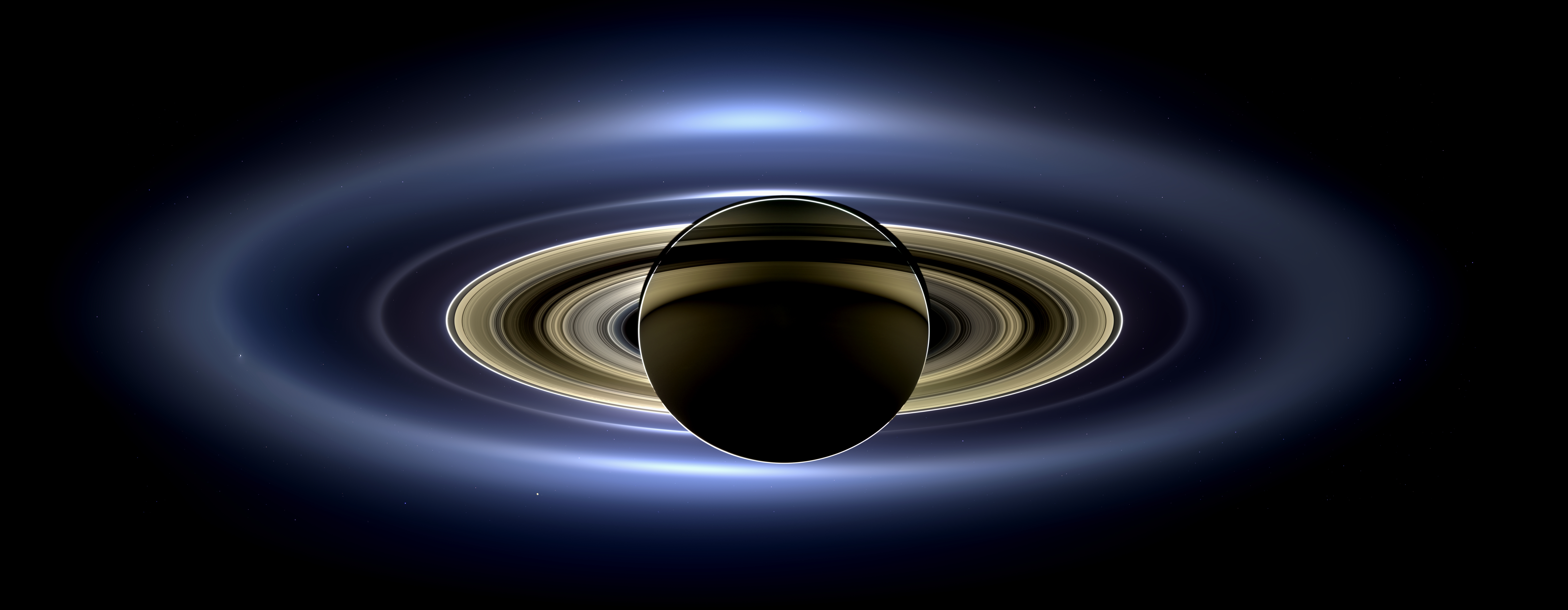
On July 19, 2013, in an event celebrated the world over, NASA's Cassini spacecraft slipped into Saturn's shadow and turned to image the planet, seven of its moons, its inner rings -- and, in the background, our home planet, Earth.

With the sun's powerful and potentially damaging rays eclipsed by Saturn itself, Cassini's onboard cameras were able to take advantage of this unique viewing geometry. They acquired a panoramic mosaic of the Saturn system that allows scientists to see details in the rings and throughout the system as they are backlit by the sun. This mosaic is special as it marks the third time our home planet was imaged from the outer solar system; the second time it was imaged by Cassini from Saturn's orbit; and the first time ever that inhabitants of Earth were made aware in advance that their photo would be taken from such a great distance.

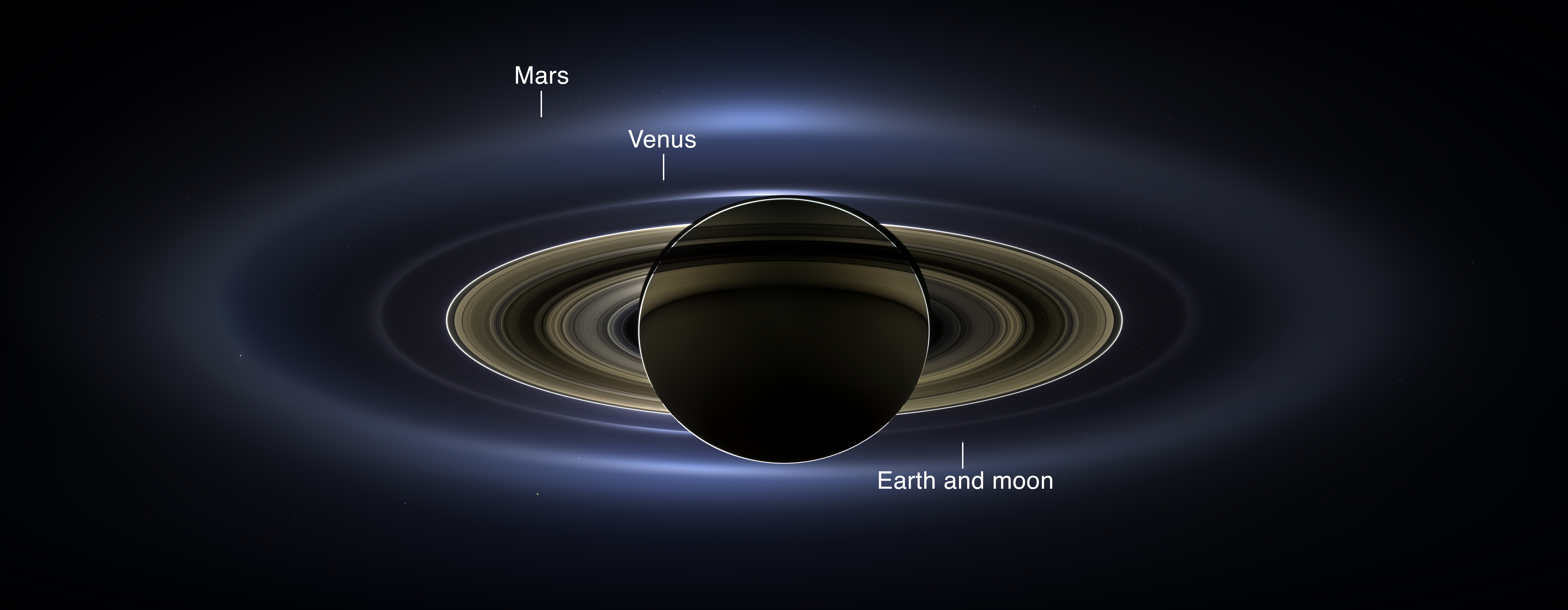
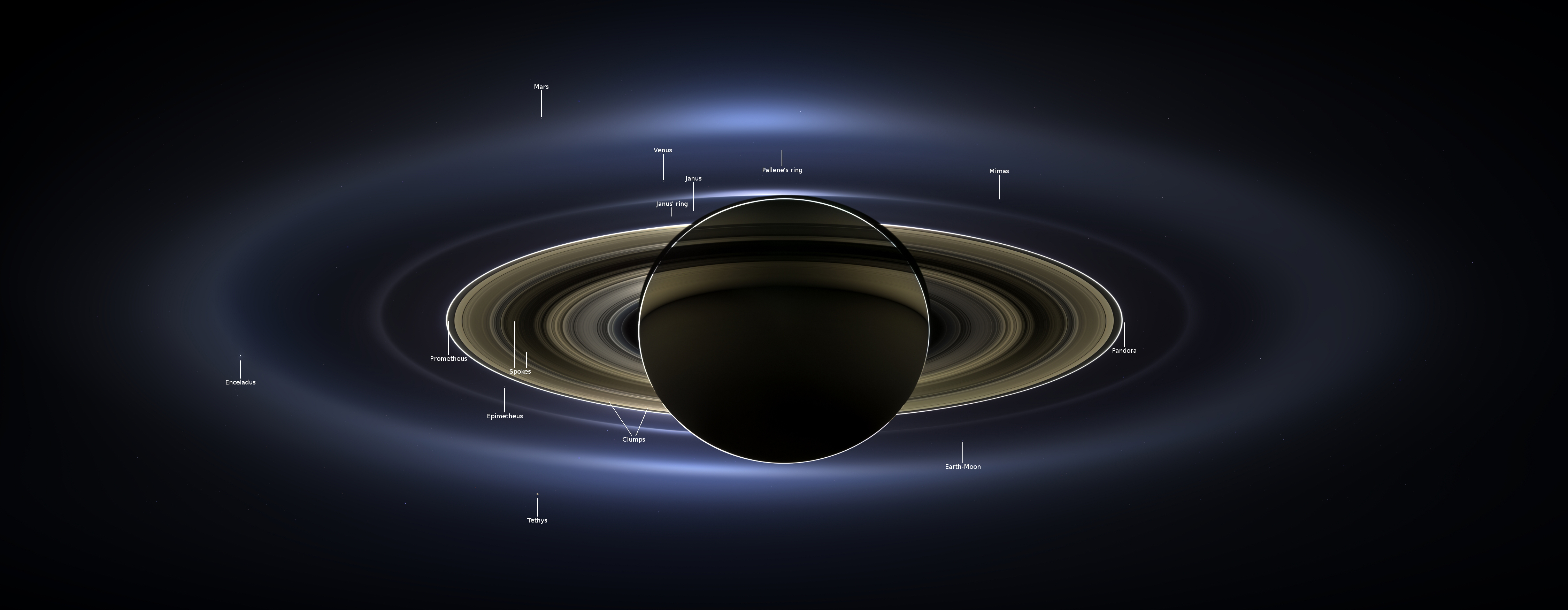
With both Cassini's wide-angle and narrow-angle cameras aimed at Saturn, Cassini was able to capture 323 images in just over four hours. This final mosaic uses 141 of those wide-angle images. Images taken using the red, green and blue spectral filters of the wide-angle camera were combined and mosaicked together to create this natural-color view. A brightened version with contrast and color enhanced (Figure 1), a version with just the planets annotated (Figure 2), and an annotated version (Figure 3) are shown above.

This image spans about 404,880 miles (651,591 kilometers) across.

The outermost ring shown here is Saturn's E ring, the core of which is situated about 149,000 miles (240,000 kilometers) from Saturn. The geysers erupting from the south polar terrain of the moon Enceladus supply the fine icy particles that comprise the E ring; diffraction by sunlight gives the ring its blue color. Enceladus (313 miles, or 504 kilometers, across) and the extended plume formed by its jets are visible, embedded in the E ring on the left side of the mosaic.

At the 12 o'clock position and a bit inward from the E ring lies the barely discernible ring created by the tiny, Cassini-discovered moon, Pallene (3 miles, or 4 kilometers, across). (For more on structures like Pallene's ring, see PIA08328). The next narrow and easily seen ring inward is the G ring. Interior to the G ring, near the 11 o'clock position, one can barely see the more diffuse ring created by the co-orbital moons, Janus (111 miles, or 179 kilometers, across) and Epimetheus (70 miles, or 113 kilometers, across). Farther inward, we see the very bright F ring closely encircling the main rings of Saturn.

Following the outermost E ring counter-clockwise from Enceladus, the moon Tethys (662 miles, or 1,066 kilometers, across) appears as a large yellow orb just outside of the E ring. Tethys is positioned on the illuminated side of Saturn; its icy surface is shining brightly from yellow sunlight reflected by Saturn. Continuing to about the 2 o'clock position is a dark pixel just outside of the G ring; this dark pixel is Saturn's Death Star moon, Mimas (246 miles, or 396 kilometers, across). Mimas appears, upon close inspection, as a very thin crescent because Cassini is looking mostly at its non-illuminated face.

The moons Prometheus, Pandora, Janus and Epimetheus are also visible in the mosaic near Saturn's bright narrow F ring. Prometheus (53 miles, or 86 kilometers, across) is visible as a faint black dot just inside the F ring and at the 9 o'clock position. On the opposite side of the rings, just outside the F ring, Pandora (50 miles, or 81 kilometers, across) can be seen as a bright white dot. Pandora and Prometheus are shepherd moons and gravitational interactions between the ring and the moons keep the F ring narrowly confined. At the 11 o'clock position in between the F ring and the G ring, Janus (111 miles, or 179 kilometers, across) appears as a faint black dot. Janus and Prometheus are dark for the same reason Mimas is mostly dark: we are looking at their non-illuminated sides in this mosaic. Midway between the F ring and the G ring, at about the 8 o'clock position, is a single bright pixel, Epimetheus. Looking more closely at Enceladus, Mimas and Tethys, especially in the brightened version of the mosaic, one can see these moons casting shadows through the E ring like a telephone pole might cast a shadow through a fog.

In the non-brightened version of the mosaic, one can see bright clumps of ring material orbiting within the Encke gap near the outer edge of the main rings and immediately to the lower left of the globe of Saturn. Also, in the dark B ring within the main rings, at the 9 o'clock position, one can see the faint outlines of two spoke features, first sighted by NASA's Voyager spacecraft in the early 1980s and extensively studied by Cassini.

Finally, in the lower right of the mosaic, in between the bright blue E ring and the faint but defined G ring, is the pale blue dot of our planet, Earth. Look closely and you can see the moon protruding from the Earth's lower right. (For a higher resolution view of the Earth and moon taken during this campaign, see PIA14949.) Earth's twin, Venus, appears as a bright white dot in the upper left quadrant of the mosaic, also between the G and E rings. Mars also appears as a faint red dot embedded in the outer edge of the E ring, above and to the left of Venus.

For ease of visibility, Earth, Venus, Mars, Enceladus, Epimetheus and Pandora were all brightened by a factor of eight and a half relative to Saturn. Tethys was brightened by a factor of four. In total, 809 background stars are visible and were brightened by a factor ranging from six, for the brightest stars, to 16, for the faintest. The faint outer rings (from the G ring to the E ring) were also brightened relative to the already bright main rings by factors ranging from two to eight, with the lower-phase-angle (and therefore fainter) regions of these rings brightened the most. The brightened version of the mosaic was further brightened and contrast-enhanced all over to accommodate print applications and a wide range of computer-screen viewing conditions.

Some ring features -- such as full rings traced out by tiny moons -- do not appear in this version of the mosaic because they require extreme computer enhancement, which would adversely affect the rest of the mosaic. This version was processed for balance and beauty.

This view looks toward the unlit side of the rings from about 17 degrees below the ring plane. Cassini was approximately 746,000 miles (1.2 million kilometers) from Saturn when the images in this mosaic were taken. Image scale on Saturn is about 45 miles (72 kilometers) per pixel.

This mosaic was made from pictures taken over a span of more than four hours while the planets, moons and stars were all moving relative to Cassini. Thus, due to spacecraft motion, these objects in the locations shown here were not in these specific places over the entire duration of the imaging campaign. Note also that Venus appears far from Earth, as does Mars, because they were on the opposite side of the sun from Earth.

Image credit: NASA/JPL-Caltech/SSI

Note: For more information, see NASA Cassini Spacecraft Provides New View of Saturn and Earth, PIA17679: The Faces of 'Wave at Saturn' and Spectacular New View of Saturn and Earth. From earlier in the year, see Cassini to Photograph Earth From Deep Space and Cassini Releases Image of Earth Waving at Saturn.

Tuesday, November 12, 2013

F-Ring Mini-Jet


A single jet feature appears to leap from the F ring of Saturn in this image from the Cassini spacecraft. A closer inspection suggests that in reality there are a few smaller jets that make up this feature, suggesting a slightly more complex origin process.

These "jets," like much of the dynamic and changing F ring, are believed by scientists to be caused by the ring's particles interacting with small moons orbiting nearby.

This view looks toward the unilluminated side of the rings from about 45 degrees below the ringplane. The image was taken in visible light with the Cassini spacecraft narrow-angle camera on June 20, 2013.

The view was obtained at a distance of approximately 870,000 miles (1.4 million kilometers) from Saturn and at a Sun-Saturn-spacecraft, or phase, angle of 77 degrees. Image scale is 5 miles (8 kilometers) per pixel.

Photo credit: NASA/JPL-Caltech/Space Science Institute

Saturday, October 26, 2013

Saturn


A swing high above Saturn by NASA's Cassini spacecraft revealed this stately view of the golden-hued planet and its main rings. The view is in natural color, as human eyes would have seen it. This mosaic was made from 36 images in three color filters obtained by Cassini's imaging science subsystem on October 10, 2013. The observation and resulting image mosaic were planned as one of three images for Cassini's 2013 Scientist for a Day essay contest.

Saturn sports differently colored bands of weather in this image. For instance, a bright, narrow wave of clouds around 42 degrees north latitude appears to be some of the turbulent aftermath of a giant storm that reached its violent peak in early 2011. The mysterious six-sided weather pattern known as the hexagon is visible around Saturn's north pole.

When Cassini arrived in 2004, more of the northern hemisphere sported a bluish hue and it was northern winter. The golden tones dominated the southern hemisphere, where it was southern summer. But as the seasons have turned and northern spring is in full swing, the colors have begun to change in each hemisphere as well. Golden tones have started to dominate in the northern hemisphere and the bluish color in the north is now confined to a tighter circle around the north pole. The southern hemisphere has started getting bluer, too.

The rings shown here include Saturn's main rings. The innermost D ring, and the C, B and A rings are easily seen. The F ring is also there, but not easily seen without enhancing the contrast of the image. (Rings were named in order of their discovery rather than their position around Saturn.) The rings also cast a shadow on Saturn at the limb of the planet in the lower right quadrant.

Cassini is currently in a set of tilted orbits known as "inclined orbits" that allow it to swing up over the north pole and below the south pole. Much of Cassini's time is spent close to the equatorial plane, where most of Saturn's rings and moons are located.

Image credit: NASA/JPL-Caltech/SSI/Cornell

Note: For more information, see Cassini Swings Above Saturn to Compose a Portrait.

Tuesday, October 22, 2013

Prometheus and Pan


Although their gravitational effects on nearby ring material look quite different, Prometheus and Pan -- pictured here -- are both shepherd moons, holding back nearby ring edges.

Pan (17 miles,or 28 kilometers across), near the right edge of the image, holds open the Encke gap that it orbits in. Prometheus (53 miles, or 86 kilometers across), near the upper left, helps shape the F ring and maintain its narrow form.

This view looks toward the unilluminated side of the rings from about 47 degrees below the ringplane. The image was taken in visible light with the Cassini spacecraft narrow-angle camera on May 27, 2013.

The view was acquired at a distance of approximately 870,000 miles (1.4 million kilometers) from Saturn and at a Sun-Saturn-spacecraft, or phase, angle of 81 degrees. Image scale is 5 miles (8 kilometers) per pixel.

Photo credit: NASA/JPL-Caltech/Space Science Institute

Saturday, October 19, 2013

Janus


The irregularly shaped moon Janus keeps up its lonely orbit. Even though Janus shares its orbit with the moon Epimetheus, they never get very close to one another thanks to the gravitational resonance that swaps their orbits roughly every four years and ensures that they don't collide.

This view looks toward the anti-Saturn side of Janus. North on Janus is up and rotated 32 degrees to the right. The image was taken in visible light with the Cassini spacecraft narrow-angle camera on June 15, 2013.

The view was obtained at a distance of approximately 750,000 miles (1.2 million kilometers) from Janus and at a Sun-Janus-spacecraft, or phase, angle of 8 degrees. Image scale is 4 miles (7 kilometers) per pixel. The F ring has been brightened by a factor of 1.4 relative to the rest of the image to enhance visibility.

Photo credit: NASA/JPL-Caltech/Space Science Institute

Tuesday, September 17, 2013

F-Ring Mini-Jet


A beautiful "mini-jet" appears in the dynamic F ring of Saturn. Saturn's A ring (including the Keeler gap and just a hint of the Encke gap at the upper-right) also appears.

The mini-jets are thought by imaging scientists to be caused by low-speed collisions in the F ring ejecting dusty material from the ring's core. For more on the mini-jets, see PIA15504.

This view looks toward the unilluminated side of the rings from about 48 degrees below the ringplane. The image was taken in visible light with the Cassini spacecraft narrow-angle camera on June 20, 2013.

The view was obtained at a distance of approximately 841,000 miles (1.4 million kilometers) from Saturn and at a Sun-Saturn-spacecraft, or phase, angle of 82 degrees. Image scale is 5 miles (8 kilometers) per pixel.

Photo credit: NASA/JPL-Caltech/Space Science Institute

Tuesday, August 13, 2013

Epimetheus and the A and F Rings


Although Epimetheus appears to be orbiting between the A and F rings in this image, it's just an illusion! Epimetheus, which orbits Saturn well outside of the F ring's orbit, is actually on the near side of Saturn to Cassini while the rings seen here are on the far side of the planet. Whew, that's a relief!

This view looks toward the unilluminated side of the rings from about 3 degrees below the ringplane. The image was taken in visible light with the Cassini spacecraft narrow-angle camera on April 15, 2013.

The view was acquired at a distance of approximately 700,000 miles (1.1 million kilometers) from Epimetheus and at a Sun-Epimetheus-spacecraft, or phase, angle of 30 degrees. Image scale is 4 miles (7 kilometers) per pixel.

Photo credit: NASA/JPL-Caltech/Space Science Institute

Tuesday, July 23, 2013

The Earth, by Cassini


In this rare image taken on July 19, 2013, the wide-angle camera on NASA's Cassini spacecraft has captured Saturn's rings and our planet Earth and its moon in the same frame. It is only one footprint in a mosaic of 33 footprints covering the entire Saturn ring system (including Saturn itself). At each footprint, images were taken in different spectral filters for a total of 323 images: some were taken for scientific purposes and some to produce a natural color mosaic. This is the only wide-angle footprint that has the Earth-moon system in it.

The dark side of Saturn, its bright limb, the main rings, the F ring, and the G and E rings are clearly seen; the limb of Saturn and the F ring are overexposed. The "breaks" in the brightness of Saturn's limb are due to the shadows of the rings on the globe of Saturn, preventing sunlight from shining through the atmosphere in those regions. The E and G rings have been brightened for better visibility.

Earth, which is 898 million miles (1.44 billion kilometers) away in this image, appears as a blue dot at center right; the moon can be seen as a fainter protrusion off its right side. An arrow indicates their location in the annotated version. (The two are clearly seen as separate objects in the accompanying narrow angle frame: PIA14949.) The other bright dots nearby are stars.

This is only the third time ever that Earth has been imaged from the outer solar system. The acquisition of this image, along with the accompanying composite narrow- and wide-angle image of Earth and the moon and the full mosaic from which both are taken, marked the first time that inhabitants of Earth knew in advance that their planet was being imaged. That opportunity allowed people around the world to join together in social events to celebrate the occasion.

This view looks toward the unilluminated side of the rings from about 20 degrees below the ring plane.

Images taken using red, green and blue spectral filters were combined to create this natural color view. The images were obtained with the Cassini spacecraft wide-angle camera on July 19, 2013 at a distance of approximately 753,000 miles (1.212 million kilometers) from Saturn, and approximately 898.414 million miles (1.445858 billion kilometers) from Earth. Image scale on Saturn is 43 miles (69 kilometers) per pixel; image scale on the Earth is 53,820 miles (86,620 kilometers) per pixel. The illuminated areas of neither Earth nor the Moon are resolved here. Consequently, the size of each "dot" is the same size that a point of light of comparable brightness would have in the wide-angle camera.

Photo credit: NASA/JPL-Caltech/Space Science Institute

Note: For more information, see NASA Releases Images of Earth by Distant Spacecraft, PIA17170: One Special Day in the Life of Planet Earth -- Close-Up (which clearly shows the Earth and Moon as two separate objects), PIA17038: Two Views of Home (which shows the Earth taken by both Cassini, around Saturn, and Messenger, around Mercury, on the same day), PIA14949: One Special Day in the Life of Planet Earth, and Pale Blue Dot: Distant Spacecraft Photograph Earth.  Also, previously, Cassini Probe to Take Photo of Earth From Deep Space.