Tuesday, August 26, 2014

Two Ringlets in the Encke Gap


Although it appears empty from a distance, the Encke gap in Saturn's A ring has three ringlets threaded through it, two of which are visible here.

Each ringlet has dynamical structure such as the clumps seen in this image. The clumps move about and even appear and disappear, in part due to the gravitational effects of Pan.

This view looks toward the sunlit side of the rings from about 27 degrees above the ringplane. The image was taken in visible light with the Cassini spacecraft narrow-angle camera on May 11, 2013.

The view was obtained at a distance of approximately 199,000 miles (321,000 kilometers) from Saturn and at a Sun-Saturn-spacecraft, or phase, angle of 121 degrees. Image scale is 1 mile (2 kilometers) per pixel.

Image credit: NASA/JPL-Caltech/Space Science Institute

Tuesday, August 19, 2014

Saturn From Above


Saturn reigns supreme, encircled by its retinue of rings.

Although all four giant planets have ring systems, Saturn's is by far the most massive and impressive. Scientists are trying to understand why by studying how the rings have formed and how they have evolved over time.

Also seen in this image is Saturn's famous north polar vortex and hexagon.

This view looks toward the sunlit side of the rings from about 37 degrees above the ringplane. The image was taken with the Cassini spacecraft wide-angle camera on May 4, 2014 using a spectral filter which preferentially admits wavelengths of near-infrared light centered at 752 nanometers.

The view was acquired at a distance of approximately 2 million miles (3 million kilometers) from Saturn. Image scale is 110 miles (180 kilometers) per pixel.

Image credit: NASA/JPL-Caltech/Space Science Institute

Note: For more information, see Supreme Saturn.

Thursday, August 14, 2014

Methane Clouds Over Titan's Ligeia Mare


This animated sequence of Cassini images shows methane clouds moving above the large methane sea on Saturn's moon Titan known as Ligeia Mare.

The spacecraft captured the views between July 20 and July 22, 2014, as it departed Titan following a flyby. Cassini tracked the system of clouds as it developed and dissipated over Ligeia Mare during this two-day period. Measurements of the cloud motions indicate wind speeds of around 7 to 10 miles per hour (3 to 4.5 meters per second).

The timing between exposures in the sequence varies. In particular, there is a 17.5-hour jump between the second and third frames. Most other frames are separated by one to two hours.

A separate view, PIA18421, shows the location of these clouds relative to features in Titan's north polar region.

Animation credit: NASA/JPL-Caltech/Space Science Institute

Note: For more information, see Cassini Tracks Clouds Developing Over a Titan Sea.

Wednesday, August 13, 2014

Rhea and Epimetheus


Saturn has a great many more moons than our planet – a whopping 62. A single moon, Titan, accounts for an overwhelming 96% of all the material orbit the planet, with a group of six other smaller moons dominating the rest. The other 55 small satellites whizzing around Saturn make up the tiny remainder along with the gas giant’s famous rings.

One of the subjects of this Cassini image, Rhea, belongs to that group of six. Set against a backdrop showing Saturn and its intricate system of icy rings, Rhea dominates the scene and dwarfs its tiny companion, one of the 55 small satellites known as Epimetheus.

Although they appear to be close to one another, this is a trick of perspective – this view was obtained when Cassini was some 1.2 million km from Rhea, and 1.6 million km from Epimetheus, meaning the moons themselves had a hefty separation of 400,000 km.

However, even if they were nearer to each other, Rhea would still loom large over Epimetheus: at 1528 km across and just under half the size of our own Moon, Rhea is well over 10 times the size of Epimetheus, which is a modest 113 km across.

As is traditional for the earliest discovered moons of Saturn, both are named after figures from Greek mythology: the Titan Rhea (“mother of the gods”) and Prometheus’ brother Epimetheus (“after thinker” or “hindsight”).

This image was taken by Cassini’s narrow-angle camera on 24 March 2010. A monochrome version was previously released by NASA as PIA12638: Big and Small Before Rings.

Image credit: Image data credit: NASA/JPL-Caltech/Space Science Institute; Processed image copyright: G. Ugarković

Tuesday, August 12, 2014

Pandora and the Rings


The F ring shepherd Pandora is captured here along with other well-known examples of how Saturn’s moons shape the rings. From the narrow F ring, to the gaps in the A ring, to the Cassini Division, Saturn's rings are a masterpiece of gravitational sculpting by the moons.

Pandora (50 miles, or 81 kilometers across), along with its fellow shepherd Prometheus (53 miles, or 86 kilometers across), helps confine the F ring and keep it from spreading.

This view looks toward the unilluminated side of the rings from about 31 degrees below the ringplane. The image was taken in visible light with the Cassini spacecraft wide-angle camera on March 8, 2014.

The view was obtained at a distance of approximately 533,000 miles (858,000 kilometers) from Saturn and at a Sun-Saturn-spacecraft, or phase, angle of 63 degrees. Image scale is 32 miles (51 kilometers) per pixel.

Image credit: NASA/JPL-Caltech/Space Science Institute

Note: For more information, see Shepherd and Flock.

Tuesday, August 5, 2014

Saturn's North Polar Vortex


Like a giant eye for the giant planet, Saturn's great vortex at its north pole appears to stare back at Cassini as Cassini stares at it.

Measurements have sized the "eye" at a staggering 1,240 miles (2,000 kilometers) across with cloud speeds as fast as 330 miles per hour (150 meters per second). For color views of the eye and the surrounding region, see PIA14946 and PIA14944.

The image was taken with the Cassini spacecraft narrow-angle camera on April 2, 2014 using a combination of spectral filters which preferentially admit wavelengths of near-infrared light centered at 748 nanometers.

The view was obtained at a distance of approximately 1.4 million miles (2.2 million kilometers) from Saturn and at a Sun-Saturn-spacecraft, or phase, angle of 43 degrees. Image scale is 8 miles (13 kilometers) per pixel.

Image credit: NASA/JPL-Caltech/Space Science Institute

Thursday, July 31, 2014

Elevated View of Enceladus' South Pole


This dramatic view looks across the region of Enceladus' geyser basin and down on the ends of the Baghdad and Damascus fractures that face Saturn. The image, which looks approximately in the direction of Saturn, was taken from a more elevated viewpoint than other Cassini survey images of this area of the moon's south pole.

The geysering segments of the fractures seen here are among the most active and warmest in the whole region. As seen from the spacecraft from an elevation angle of 25 degrees south, the jets are projected against the bright surface as opposed to black sky. Consequently, despite the pronounced activity, the jets appear fuzzy, or indistinct, in this image and their tilts are consequently not measurable. Though their source locations are clearly seen, this image was not used in the process of triangulation, but instead it was used to confirm source locations determined from triangulation using other images.

The image was taken with Cassini's narrow-angle camera through the clear filter on August 13, 2010, with an image scale about 230 feet (70 meters) per pixel and a Sun-Enceladus-spacecraft, or phase, angle of about 151 degrees.

This image was one of those used to confirm the sources of Enceladus' geysers as described in a paper by Porco, DiNino, and Nimmo, and published in the online version of the Astronomical Journal in July 2014: http://dx.doi.org/10.1088/0004-6256/148/3/45.

A companion paper, by Nimmo et al. is available at: http://dx.doi.org/10.1088/0004-6256/148/3/46.


Image credit: NASA/JPL-Caltech/Space Science Institute

Note: For more information, see PIA17186: Geyser Basin in 3-D, PIA17187: Enceladus' Plume Brightness Variations, PIA17188: Surveyor's Map of Enceladus' Geyser Basin, PIA17189: What Lies Beneath: Close Up View (Artist's Concept), PIA17190: What Lies Beneath: Regional View (Artist's Concept), and Cassini Spacecraft Reveals 101 Geysers and More on Icy Saturn Moon.

Wednesday, July 30, 2014

Enceladus Geysers


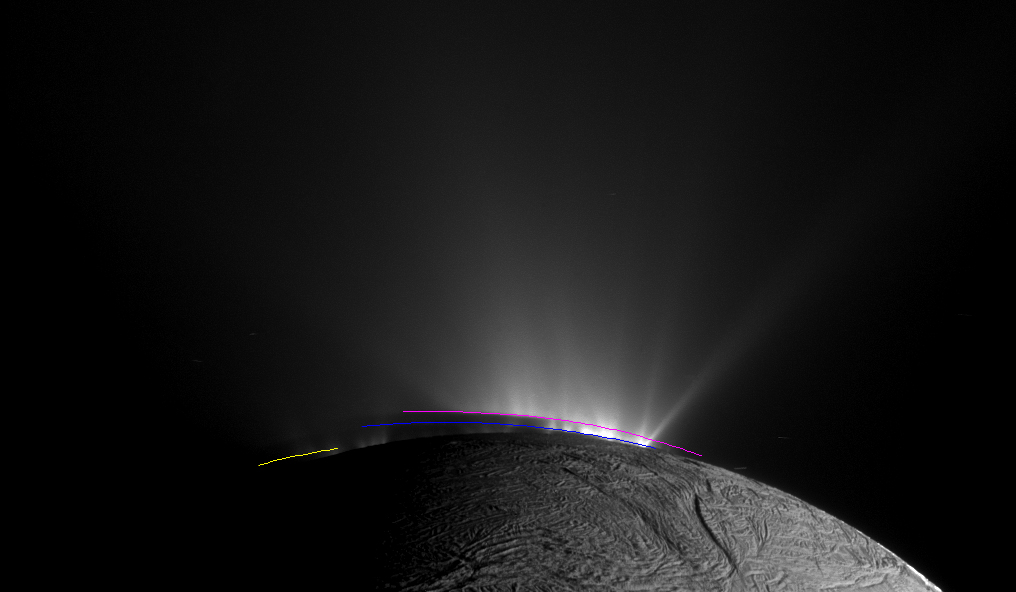
This Cassini narrow-angle camera image -- one of those acquired in the survey conducted by the Cassini imaging science team of the geyser basin at the south pole of Enceladus -- was taken as Cassini was looking across the moon's south pole. At the time, the spacecraft was essentially in the moon's equatorial plane. The image scale is 1280 feet (390 meters) per pixel and the sun-Enceladus-spacecraft, or phase, angle is 162.5 degrees.

The image was taken through the clear filter of the narrow angle camera on November 30, 2010, 1.4 years after southern autumnal equinox. The shadow of the body of Enceladus on the lower portions of the jets is clearly seen.

In an annotated version of the image, the colored lines represent the projection of Enceladus' shadow on a plane normal to the branch of the Cairo fracture (yellow line), normal to the Baghdad fracture (blue line) and normal to the Damascus fracture (pink line).

Post-equinox images like this, clearly showing the different projected locations of the intersection between the shadow and the curtain of jets from each fracture, were useful for scientists in checking the triangulated positions of the geysers, as described in a paper by Porco, DiNino, and Nimmo, and published in the online version of the Astronomical Journal in July 2014: http://dx.doi.org/10.1088/0004-6256/148/3/45.

A companion paper, by Nimmo et al. is available at: http://dx.doi.org/10.1088/0004-6256/148/3/46.

Image credit: NASA/JPL-Caltech/Space Science Institute

Note: For more information, see 101 Geysers on Icy Saturn Moon.

Tuesday, July 29, 2014

Tethys


Tethys, like many moons in the solar system, keeps one face pointed towards the planet around which it orbits. Tethys' anti-Saturn face is seen here, fully illuminated, basking in sunlight. On the right side of the moon in this image is the huge crater Odysseus.

The Odysseus crater is 280 miles (450 kilometers) across while Tethys is 660 miles (1,062 kilometers) across. See PIA07693 for a closer view and more information on the Odysseus crater.

This view looks toward the anti-Saturn side of Tethys. North on Tethys is up and rotated 33 degrees to the right. The image was taken in visible light with the Cassini spacecraft narrow-angle camera on June 15, 2013.

The view was acquired at a distance of approximately 503,000 miles (809,000 kilometers) from Tethys. Image scale is 3 miles (5 kilometers) per pixel.

Image credit: NASA/JPL-Caltech/Space Science Institute

Tuesday, July 22, 2014

Crescent Saturn


Saturn appears to Cassini's cameras as a thin, sunlit crescent in this unearthly view. Citizens of Earth, being so much closer to the Sun than Saturn, never get to enjoy a view of Saturn like this without the aid of our robot envoys.

Parts of the night side of Saturn show faint illumination due to light reflected off the rings back onto the planet, an effect dubbed "ringshine." This view looks toward the unilluminated side of the rings from about 43 degrees below the ringplane. The image was taken in green light with the Cassini spacecraft wide-angle camera on August 4, 2013.

The view was obtained at a distance of approximately 1.2 million miles (2 million kilometers) from Saturn. Image scale is 75 miles (120 kilometers) per pixel.

Image credit: NASA/JPL-Caltech/Space Science Institute