Tuesday, November 26, 2013

Epimetheus and Daphnis


While the moon Epimetheus passes by, beyond the edge of Saturn's main rings, the tiny moon Daphnis carries on its orbit within the Keeler gap of the A ring. Although quite different in size, both moons create waves in the rings thanks to their gravitational influences.

Epimetheus (70 miles, or 113 kilometers across) is visible at the lower-right of the image, and Daphnis (5 miles, or 8 kilometers across) is barely visible at one pixel wide just below-right of the image center. A close inspection of the image also reveals the waves Daphnis creates on the edges of the Keeler gap.

This view looks toward the unilluminated side of the rings from about 2.6 degrees below the ringplane. The image was taken in visible light with the Cassini spacecraft narrow-angle camera on June 28, 2013.

The view was acquired at a distance of approximately 808,000 miles (1.3 million kilometers) from Daphnis and at a Sun-Daphnis-spacecraft, or phase, angle of 28 degrees. Image scale is 5 miles (8 kilometers) per pixel.

Photo credit: NASA/JPL-Caltech/Space Science Institute

Tuesday, November 19, 2013

Saturn in Infrared


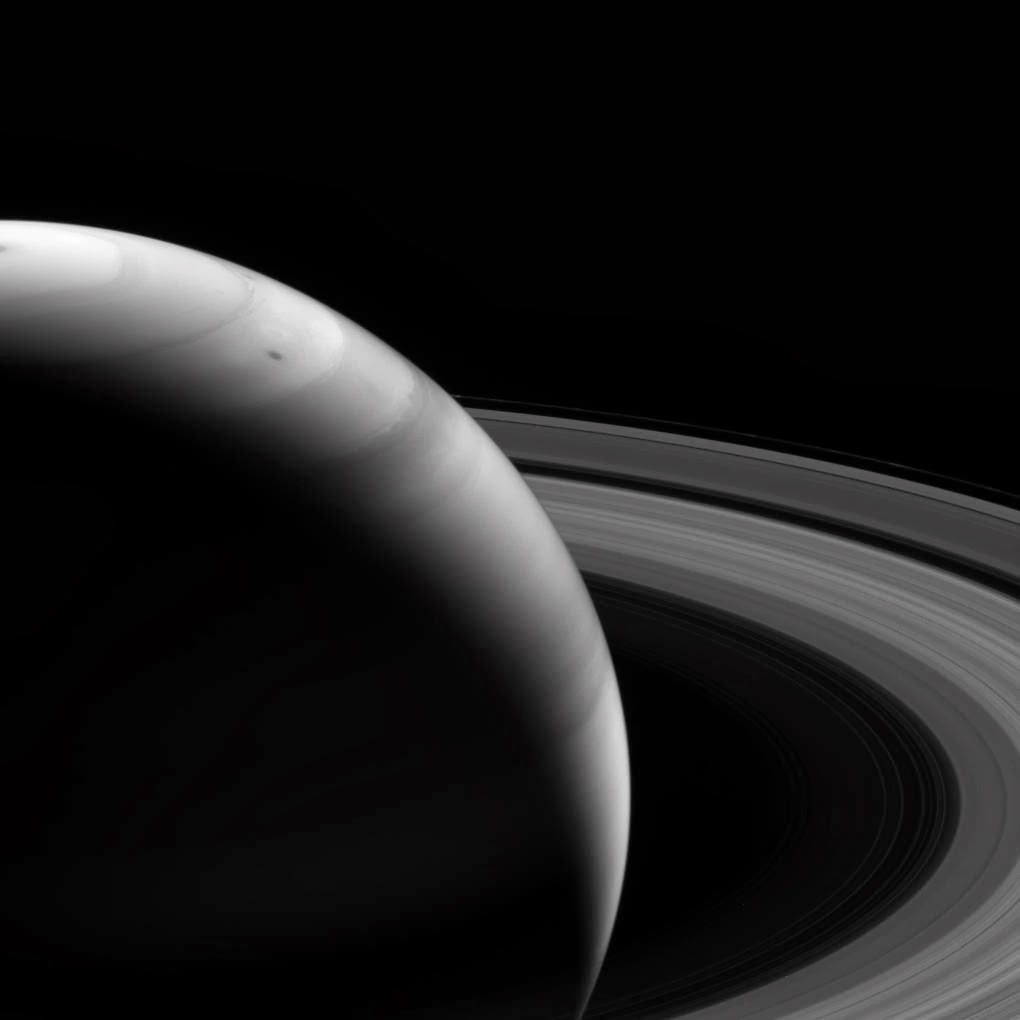
To the Cassini spacecraft's infrared eyes, Saturn's graceful clouds sometimes take on the appearance of an impressionist's painting of the giant planet.

This view looks toward the sunlit side of the rings from about 18 degrees above the ringplane. The image was taken with the Cassini spacecraft wide-angle camera on August 12, 2013 using a spectral filter sensitive to wavelengths of near-infrared light centered at 728 nanometers.

The view was acquired at a distance of approximately 994,000 miles (1.6 million kilometers) from Saturn. Image scale is 57 miles (92 kilometers) per pixel.

Image credit: NASA/JPL-Caltech/Space Science Institute

Wednesday, November 13, 2013

Saturn, with Earth, Venus and Mars


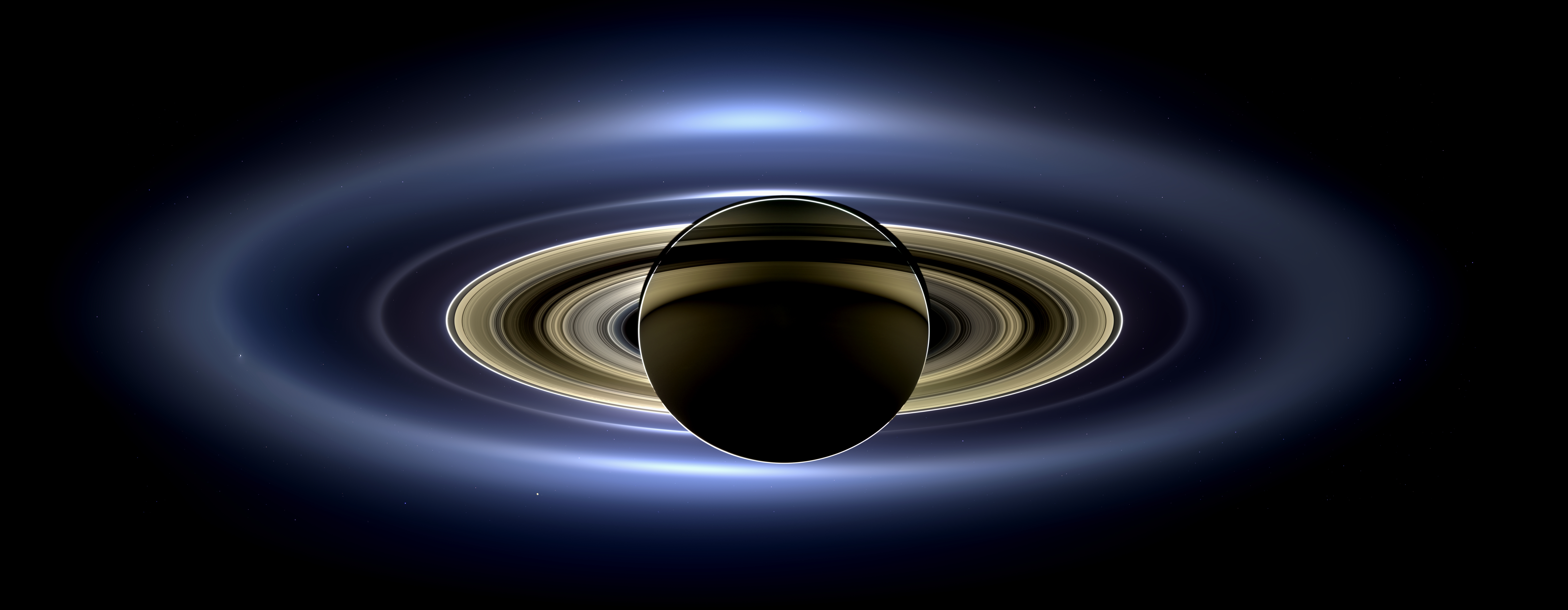
On July 19, 2013, in an event celebrated the world over, NASA's Cassini spacecraft slipped into Saturn's shadow and turned to image the planet, seven of its moons, its inner rings -- and, in the background, our home planet, Earth.

With the sun's powerful and potentially damaging rays eclipsed by Saturn itself, Cassini's onboard cameras were able to take advantage of this unique viewing geometry. They acquired a panoramic mosaic of the Saturn system that allows scientists to see details in the rings and throughout the system as they are backlit by the sun. This mosaic is special as it marks the third time our home planet was imaged from the outer solar system; the second time it was imaged by Cassini from Saturn's orbit; and the first time ever that inhabitants of Earth were made aware in advance that their photo would be taken from such a great distance.

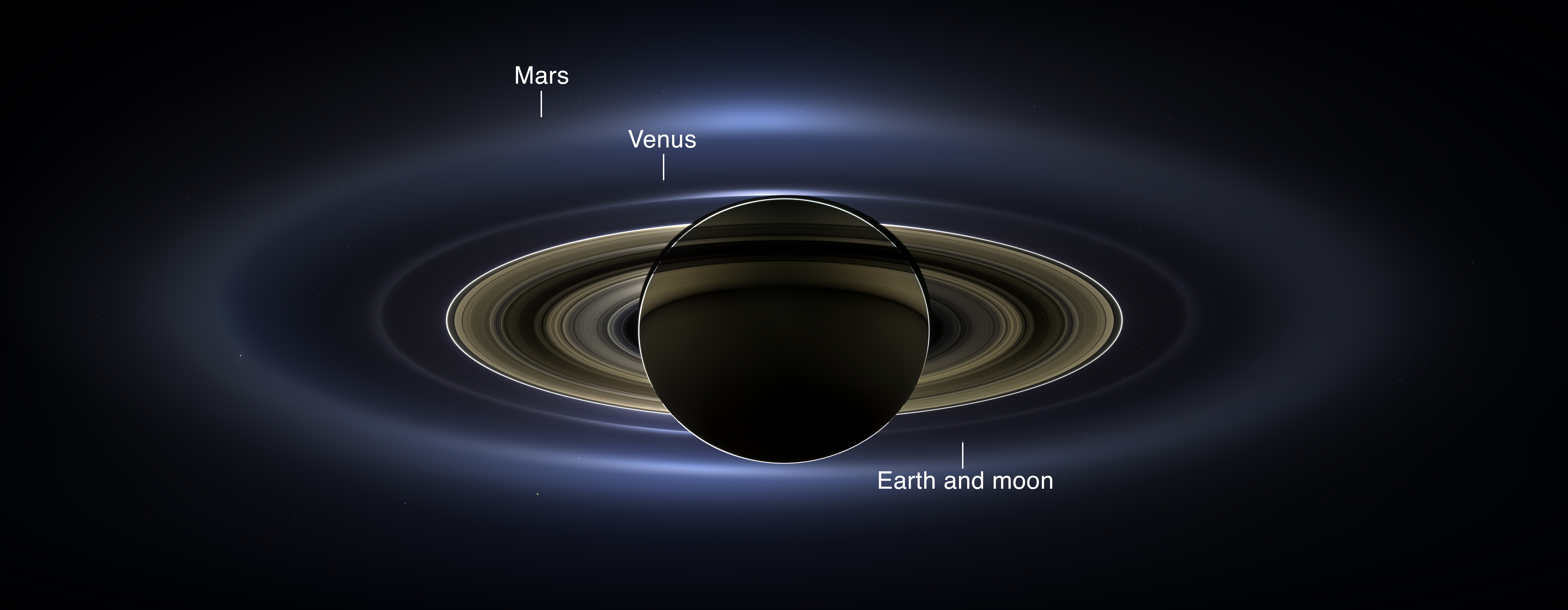
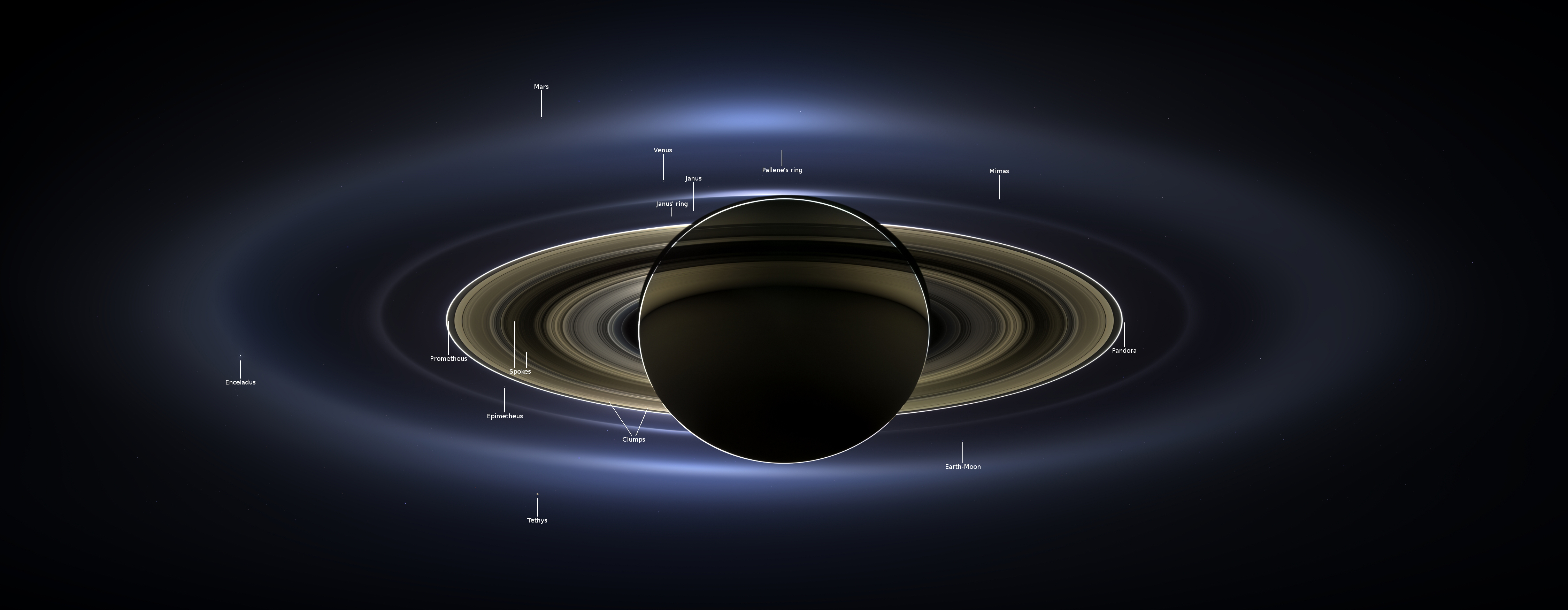
With both Cassini's wide-angle and narrow-angle cameras aimed at Saturn, Cassini was able to capture 323 images in just over four hours. This final mosaic uses 141 of those wide-angle images. Images taken using the red, green and blue spectral filters of the wide-angle camera were combined and mosaicked together to create this natural-color view. A brightened version with contrast and color enhanced (Figure 1), a version with just the planets annotated (Figure 2), and an annotated version (Figure 3) are shown above.

This image spans about 404,880 miles (651,591 kilometers) across.

The outermost ring shown here is Saturn's E ring, the core of which is situated about 149,000 miles (240,000 kilometers) from Saturn. The geysers erupting from the south polar terrain of the moon Enceladus supply the fine icy particles that comprise the E ring; diffraction by sunlight gives the ring its blue color. Enceladus (313 miles, or 504 kilometers, across) and the extended plume formed by its jets are visible, embedded in the E ring on the left side of the mosaic.

At the 12 o'clock position and a bit inward from the E ring lies the barely discernible ring created by the tiny, Cassini-discovered moon, Pallene (3 miles, or 4 kilometers, across). (For more on structures like Pallene's ring, see PIA08328). The next narrow and easily seen ring inward is the G ring. Interior to the G ring, near the 11 o'clock position, one can barely see the more diffuse ring created by the co-orbital moons, Janus (111 miles, or 179 kilometers, across) and Epimetheus (70 miles, or 113 kilometers, across). Farther inward, we see the very bright F ring closely encircling the main rings of Saturn.

Following the outermost E ring counter-clockwise from Enceladus, the moon Tethys (662 miles, or 1,066 kilometers, across) appears as a large yellow orb just outside of the E ring. Tethys is positioned on the illuminated side of Saturn; its icy surface is shining brightly from yellow sunlight reflected by Saturn. Continuing to about the 2 o'clock position is a dark pixel just outside of the G ring; this dark pixel is Saturn's Death Star moon, Mimas (246 miles, or 396 kilometers, across). Mimas appears, upon close inspection, as a very thin crescent because Cassini is looking mostly at its non-illuminated face.

The moons Prometheus, Pandora, Janus and Epimetheus are also visible in the mosaic near Saturn's bright narrow F ring. Prometheus (53 miles, or 86 kilometers, across) is visible as a faint black dot just inside the F ring and at the 9 o'clock position. On the opposite side of the rings, just outside the F ring, Pandora (50 miles, or 81 kilometers, across) can be seen as a bright white dot. Pandora and Prometheus are shepherd moons and gravitational interactions between the ring and the moons keep the F ring narrowly confined. At the 11 o'clock position in between the F ring and the G ring, Janus (111 miles, or 179 kilometers, across) appears as a faint black dot. Janus and Prometheus are dark for the same reason Mimas is mostly dark: we are looking at their non-illuminated sides in this mosaic. Midway between the F ring and the G ring, at about the 8 o'clock position, is a single bright pixel, Epimetheus. Looking more closely at Enceladus, Mimas and Tethys, especially in the brightened version of the mosaic, one can see these moons casting shadows through the E ring like a telephone pole might cast a shadow through a fog.

In the non-brightened version of the mosaic, one can see bright clumps of ring material orbiting within the Encke gap near the outer edge of the main rings and immediately to the lower left of the globe of Saturn. Also, in the dark B ring within the main rings, at the 9 o'clock position, one can see the faint outlines of two spoke features, first sighted by NASA's Voyager spacecraft in the early 1980s and extensively studied by Cassini.

Finally, in the lower right of the mosaic, in between the bright blue E ring and the faint but defined G ring, is the pale blue dot of our planet, Earth. Look closely and you can see the moon protruding from the Earth's lower right. (For a higher resolution view of the Earth and moon taken during this campaign, see PIA14949.) Earth's twin, Venus, appears as a bright white dot in the upper left quadrant of the mosaic, also between the G and E rings. Mars also appears as a faint red dot embedded in the outer edge of the E ring, above and to the left of Venus.

For ease of visibility, Earth, Venus, Mars, Enceladus, Epimetheus and Pandora were all brightened by a factor of eight and a half relative to Saturn. Tethys was brightened by a factor of four. In total, 809 background stars are visible and were brightened by a factor ranging from six, for the brightest stars, to 16, for the faintest. The faint outer rings (from the G ring to the E ring) were also brightened relative to the already bright main rings by factors ranging from two to eight, with the lower-phase-angle (and therefore fainter) regions of these rings brightened the most. The brightened version of the mosaic was further brightened and contrast-enhanced all over to accommodate print applications and a wide range of computer-screen viewing conditions.

Some ring features -- such as full rings traced out by tiny moons -- do not appear in this version of the mosaic because they require extreme computer enhancement, which would adversely affect the rest of the mosaic. This version was processed for balance and beauty.

This view looks toward the unlit side of the rings from about 17 degrees below the ring plane. Cassini was approximately 746,000 miles (1.2 million kilometers) from Saturn when the images in this mosaic were taken. Image scale on Saturn is about 45 miles (72 kilometers) per pixel.

This mosaic was made from pictures taken over a span of more than four hours while the planets, moons and stars were all moving relative to Cassini. Thus, due to spacecraft motion, these objects in the locations shown here were not in these specific places over the entire duration of the imaging campaign. Note also that Venus appears far from Earth, as does Mars, because they were on the opposite side of the sun from Earth.

Image credit: NASA/JPL-Caltech/SSI

Note: For more information, see NASA Cassini Spacecraft Provides New View of Saturn and Earth, PIA17679: The Faces of 'Wave at Saturn' and Spectacular New View of Saturn and Earth. From earlier in the year, see Cassini to Photograph Earth From Deep Space and Cassini Releases Image of Earth Waving at Saturn.

Tuesday, November 12, 2013

F-Ring Mini-Jet


A single jet feature appears to leap from the F ring of Saturn in this image from the Cassini spacecraft. A closer inspection suggests that in reality there are a few smaller jets that make up this feature, suggesting a slightly more complex origin process.

These "jets," like much of the dynamic and changing F ring, are believed by scientists to be caused by the ring's particles interacting with small moons orbiting nearby.

This view looks toward the unilluminated side of the rings from about 45 degrees below the ringplane. The image was taken in visible light with the Cassini spacecraft narrow-angle camera on June 20, 2013.

The view was obtained at a distance of approximately 870,000 miles (1.4 million kilometers) from Saturn and at a Sun-Saturn-spacecraft, or phase, angle of 77 degrees. Image scale is 5 miles (8 kilometers) per pixel.

Photo credit: NASA/JPL-Caltech/Space Science Institute

Wednesday, November 6, 2013

Tethys


The craters of Tethys tell the story of a violent history marked by impacts. The names of the craters also tell oft-violent stories: in this case, the Iliad and the Odyssey. Here, we see the craters Melanthius (near the center, at the day/night terminator), Dolius (above Melanthius), and Penelope (upper left almost over the limb). Penelope was the faithful and wise wife of the Greek hero Odysseus, Dolius was their loyal gardener, and Melanthius was Dolius' son.

This view looks toward the leading side of Tethys. North on Tethys is up and rotated 32 degrees to the right. The image was taken in visible light with the Cassini spacecraft narrow-angle camera on May 16, 2013.

The view was obtained at a distance of approximately 684,000 miles (1.1 million kilometers) from Tethys and at a Sun-Tethys-spacecraft, or phase, angle of 63 degrees. Image scale is 4 miles (7 kilometers) per pixel. The image has been zoomed in by a factor of 1.5.

Photo credit: NASA/JPL-Caltech/Space Science Institute

Tuesday, November 5, 2013

Quintet of Moons


Five moons pose for the international Cassini spacecraft to create this beautiful portrait with Saturn’s rings.

This view, from 29 July 2011, looks toward the northern, sunlit side of the rings from just above the ringplane.

At the far right, and obscuring Saturn itself, is the planet’s second largest moon Rhea, which spans 1528 km. Rhea is closest to Cassini in this composition, at a distance of 1.1 million kilometers. Its heavily cratered surface bears witness to a violent history, with many craters overlapping or erasing the traces of older impact events.

The nearly 400 km-wide Mimas lies just beyond, and seemingly levitates just above Saturn’s innermost rings. The outline of the moon’s large, distinguishing crater Herschel is partially covered by Rhea, but can just be made out along with numerous smaller craters.

Brightly reflective Enceladus appears above the center of the image and lies beyond the rings, at a distance of 1.8 million kilometers from Cassini. Although not visible in this image, icy Enceladus is covered with a network of frozen ridges and troughs, with plumes of ice particles jetting from fissures in its southern hemisphere.

To the lower left, tiny Pandora, just 81 km across, appears skewered by Saturn’s outer rings – in fact, it orbits between the planet’s A and F rings.

Last but not least, the irregularly shaped Janus lies at the far left of the image, several shadowy surface markings corresponding to large impact craters.

Photo credit: NASA/JPL-Caltech/Space Science Institute

Tuesday, October 29, 2013

Senkyo


The Cassini spacecraft once again dons its special infrared glasses to peer through Titan's haze and monitor its surface. Here, Cassini has recaptured the equatorial region dubbed "Senkyo." The dark features are believed to be vast dunes of hydrocarbon particles that precipitated out of Titan's atmosphere.

Titan, Saturn's largest moon, is 3,200 miles (5,150 kilometers) across. For more on Senkyo, see PIA08231.

This view looks toward Saturn-facing hemisphere of Titan. North on Titan is up and rotated 4 degrees to the left. The image was taken with the Cassini spacecraft narrow-angle camera on June 16, 2013 using a spectral filter sensitive to wavelengths of near-infrared light centered at 938 nanometers.

Image credit: NASA/JPL-Caltech/Space Science Institute

Saturday, October 26, 2013

Saturn


A swing high above Saturn by NASA's Cassini spacecraft revealed this stately view of the golden-hued planet and its main rings. The view is in natural color, as human eyes would have seen it. This mosaic was made from 36 images in three color filters obtained by Cassini's imaging science subsystem on October 10, 2013. The observation and resulting image mosaic were planned as one of three images for Cassini's 2013 Scientist for a Day essay contest.

Saturn sports differently colored bands of weather in this image. For instance, a bright, narrow wave of clouds around 42 degrees north latitude appears to be some of the turbulent aftermath of a giant storm that reached its violent peak in early 2011. The mysterious six-sided weather pattern known as the hexagon is visible around Saturn's north pole.

When Cassini arrived in 2004, more of the northern hemisphere sported a bluish hue and it was northern winter. The golden tones dominated the southern hemisphere, where it was southern summer. But as the seasons have turned and northern spring is in full swing, the colors have begun to change in each hemisphere as well. Golden tones have started to dominate in the northern hemisphere and the bluish color in the north is now confined to a tighter circle around the north pole. The southern hemisphere has started getting bluer, too.

The rings shown here include Saturn's main rings. The innermost D ring, and the C, B and A rings are easily seen. The F ring is also there, but not easily seen without enhancing the contrast of the image. (Rings were named in order of their discovery rather than their position around Saturn.) The rings also cast a shadow on Saturn at the limb of the planet in the lower right quadrant.

Cassini is currently in a set of tilted orbits known as "inclined orbits" that allow it to swing up over the north pole and below the south pole. Much of Cassini's time is spent close to the equatorial plane, where most of Saturn's rings and moons are located.

Image credit: NASA/JPL-Caltech/SSI/Cornell

Note: For more information, see Cassini Swings Above Saturn to Compose a Portrait.

Thursday, October 24, 2013

Titan's North Polar Lakes and Evaporite Deposits


This false-color mosaic, made from infrared data collected by NASA's Cassini spacecraft, reveals the differences in the composition of surface materials around hydrocarbon lakes at Titan, Saturn's largest moon. Titan is the only other place in the solar system that we know has stable liquid on its surface, though its lakes are made of liquid ethane and methane rather than liquid water. While there is one large lake and a few smaller ones near Titan's south pole, almost all of Titan's lakes appear near the moon's north pole.

Scientists mapped near-infrared colors onto the visible color spectrum. Red in this image was assigned a wavelength of 5 microns (10 times longer than visible light), green 2.0 microns (four times longer than visible light), and blue 1.3 microns (2.6 times longer than visible light).

The orange areas are thought to be evaporite -- the Titan equivalent of salt flats on Earth. The evaporated material is thought to be organic chemicals originally from Titan's haze particles that once dissolved in liquid methane. They appear orange in this image against the greenish backdrop of Titan's typical bedrock of water ice.

In this mosaic, Kraken Mare, which is Titan's largest sea and covers about the same area as Earth's Caspian Sea and Lake Superior combined, can be seen spreading out with many tendrils on the upper right,. The big dark zone up and left of Kraken is Ligeia Mare, the second largest sea. Below Ligeia, shaped similar to a sports fan's foam finger that points just up from left, is Punga Mare, the third largest Titan Sea. Numerous other smaller lakes dot the area. Titan's north pole is located in the geographic location just above the end of the "finger" of Punga Mare.

Figure 1 highlights a high-resolution strip and shows the north pole marked with a red cross. Other smaller lakes are also labeled.

The data shown here were obtained by Cassini's visual and infrared mapping spectrometer during a close flyby of Titan on September 12, 2013.

Until now, the spectrometer has only been able to capture distant, oblique or partial views of this area. The September 12, 2013, flyby provided better viewing geometry. And sunlight has begun to pierce the winter darkness that shrouded Titan's north pole at the time of Cassini's arrival in the Saturn system nine years ago. A thick cap of haze that once hung over the north pole has also dissipated as northern summer approaches. And, thankfully, Titan's beautiful, almost cloudless, rain-free weather continued during this flyby.

The resolution varies across this composite view depending on when each cube of data was acquired, but the best surface sampling is 2 miles (3 kilometers) per pixel.

Views of this area by other Cassini instruments include PIA17471, PIA17472, PIA17473 and PIA14584 from the imaging science subsystem; and PIA10008 and PIA17031 from the radar mapper. An earlier VIMS view can be seen at PIA16845.


Image credit: NASA/JPL-Caltech/University of Arizona/University of Idaho

Note: For more information, see Cassini Gets New Views of Titan's Land of Lakes.

Tuesday, October 22, 2013

Prometheus and Pan


Although their gravitational effects on nearby ring material look quite different, Prometheus and Pan -- pictured here -- are both shepherd moons, holding back nearby ring edges.

Pan (17 miles,or 28 kilometers across), near the right edge of the image, holds open the Encke gap that it orbits in. Prometheus (53 miles, or 86 kilometers across), near the upper left, helps shape the F ring and maintain its narrow form.

This view looks toward the unilluminated side of the rings from about 47 degrees below the ringplane. The image was taken in visible light with the Cassini spacecraft narrow-angle camera on May 27, 2013.

The view was acquired at a distance of approximately 870,000 miles (1.4 million kilometers) from Saturn and at a Sun-Saturn-spacecraft, or phase, angle of 81 degrees. Image scale is 5 miles (8 kilometers) per pixel.

Photo credit: NASA/JPL-Caltech/Space Science Institute